AI Agent Governance and Security Challenges in 2027: The Need for an AIOS Infrastructure

Summary
- The question for 2027 is no longer "how do we use AI?" but "can we build an organization that doesn't break judgment, accountability, or evolution as AI multiplies?"
- Gartner predicts that by 2027, 40% of enterprises will demote or decommission autonomous AI agents because of governance gaps discovered only after a production incident.
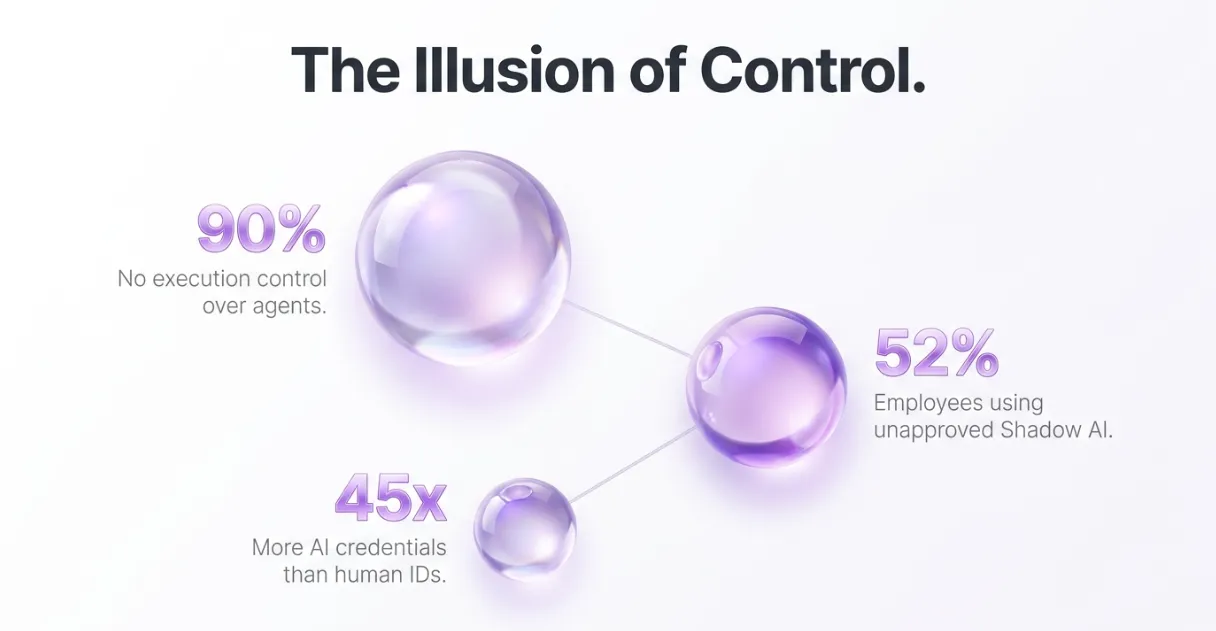
- Control has not kept up. 90% of organizations have no way to govern what agents in production are actually doing, and only 7.2% have formally named an accountable owner.
- Unapproved AI use is already normal. 52% of knowledge workers use unapproved AI tools, and 58% of organizations experienced an AI-related security incident or close call in the past year.
- Third-party risk is now real. The March 2026 LiteLLM compromise affected 2,500+ companies and 434,000 CI/CD pipelines, marking AI infrastructure as a primary attack target.
- The answer is not more point solutions. It is an AI operations OS: identity, permissions, audit, kill capability, and evolution designed as one system.
- We implement this requirement through Aezisai's AIOS platform, built around ELYSION (unified security and control plane) and ARIA (a digital twin AI that accumulates experience and judgment criteria).
1. The Nature of Failure Has Changed
The widely cited 2025 Gartner prediction — that over 40% of agentic AI projects would be canceled by the end of 2027 — was about proof-of-concept failures in organizations that had not yet deployed.
The May 2026 prediction is different. It describes organizations already running agents in production, discovering after the fact that they cannot control them. The question has shifted from "can we deploy?" to "can we operate?"
| Metric | Value |
|---|---|
| Median number of production agents | 2,650 (Dec 2025) → 76,100 (Apr 2026) |
| Monitoring coverage | ~52% (flat while agent count doubled) |
| Agents secured from deployment | 19.7% |
| Organizations with no way to govern agent behavior | 90% |
| Organizations with a formally named accountable owner | 7.2% |
| Non-human identities per human identity | 45:1 average; 144:1 in cloud-native environments |
Agent count grew roughly 29x in about a year while monitoring coverage stayed at 52%. The share of the estate that is actually governed is shrinking.
2. Five Failure Modes That Surface Quietly
Long before a dramatic incident, operations decay from the inside.
| Failure mode | What happens |
|---|---|
| Approval fatigue | Designs that require a human to approve every action degrade under time pressure. You feel safe while becoming unsafe. |
| Audit log overload | Logs exist but are too voluminous to read. You end up "auditable in theory, unauditable in practice." |
| Rogue agents | Over-tightening pushes teams outside the sanctioned path. Prohibition is not a durable strategy. |
| Orphaned credentials | Credentials from decommissioned agents remain in config files and stay exploitable indefinitely. |
| Regulatory fragmentation | Differing national and industry rules make operating models disproportionately complex for global enterprises. |
Credential abandonment is especially severe: 47% of non-human identities have gone unchanged for more than a year.
3. Why Traditional Identity Management Is Insufficient
AI agents acquire permissions at runtime, delegate tasks to other agents, and sometimes spawn new agents. Identity lifetimes can be measured in seconds.
This means traditional "who logged in?" management cannot trace what happened. What is needed is a system that decides "may this agent, acting for this user, take this action on this resource right now?"
Accountability also blurs. A human identity has an owner in the HR system; an AI identity does not. In practice, 51% of organizations report no clear ownership of AI identities.
4. AI Built in the Field, and AI Arriving Through External Services
So far this has been about AI that an organization deliberately deploys. The real risk, however, comes from agents employees build themselves and from half-baked AI arriving through external services.
4-1. Agents Built Internally and Left Ungoverned
| Data point | Value |
|---|---|
| Knowledge workers using unapproved AI tools | 52% (24% do so regularly); 48% in Japan |
| What unapproved-tool users share | Internal messages/email 54%, HR information 45%, confidential documents 39%, credentials 20%+ |
| Organizations experiencing an AI-related security incident or close call in the past 12 months | 58% |
| Organizations applying the same security controls to agents as to humans | 34% only |
| Executive confidence | 90% confident in visibility; 95% confident employees use AI responsibly (a large gap versus reality) |
| Organizations where over half of employees use AI agents regularly | 43% |
| Organizations consolidated on a single agent platform | only 5% (44% use two to three; 43% use four or more) |
| Organizations with 1–100 unsanctioned agents | 54% |
| Organizations reporting agents exceeding intended permissions | 53% |
| Organizations experiencing an agent-related security incident | 47% |
| Organizations where detection and response take 5 hours or longer | 58% |
| Organizations where 76–100% of agents have defined ownership | 15% only |
The critical insight is that rogue agents appear in the earliest adoption phases. Field usage outpaces governance, which means building an inventory later is already too late.
The pattern is identical in Japan. According to Gartner, 73% of Japanese enterprises cannot manage shadow AI — 43% have no visibility at all, and 30% have visibility but no effective countermeasures. Meanwhile, 75% of enterprises permit unapproved generative AI use under certain conditions. The question is not whether to prohibit. It is how to design control.
4-2. Half-Baked AI Agent Arriving Through External Services
AI delivered as an external service is harder to inspect than anything built in-house. Gartner estimates that of the thousands of agentic AI vendors, only about 130 are real. The majority of the market consists of products with no substantial agency — "agent-like" offerings.
And the damage is no longer theoretical.
| Event | Detail |
|---|---|
| AI infrastructure supply chain attack (March 2026) | Starting from a compromised developer tool (Trivy), specific versions of the AI gateway LiteLLM (1.82.7 / 1.82.8) were poisoned and published to PyPI. The impact reached 2,500+ companies and 434,000 CI/CD pipelines. The packages were live for only about 40 minutes, yet the stolen credentials remain valid for far longer. |
| What was stolen | Cloud credentials, repository tokens, SSH keys, Kubernetes secrets, and AI provider API keys and gateway configuration — the keys to the entire AI stack. |
| Third-party breach share | In the 2026 Verizon DBIR, third-party and supply chain breaches account for 48% of all breaches, up 60% year over year. |
The key point: the biggest exposure is not a malicious external AI — it is an ungoverned connection to an external service. The more conveniently agents can connect, the more those connection paths become the attack surface itself.
5. Regulation Is Giving You Time, But You Still Have to Comply
The EU amended parts of the AI Act's application timeline through the Digital Omnibus (Regulation (EU) 2026/1744).
| Scope | Change |
|---|---|
| High-risk AI (standalone) | August 2026 → December 2027 |
| High-risk AI (embedded in products) | August 2027 → August 2028 |
| Transparency obligations (AI-generated content labeling) | Not deferred (on the original schedule) |
| General-purpose AI (GPAI) provider obligations | Not deferred |
| Prohibited practices | Not deferred (up to €35 million or 7% of global turnover) |
Only the heaviest item — conformity assessment for high-risk systems — was deferred. The obligations did not disappear; they must be met within the new deadlines. The deferral is not a grace period for inaction; it is a preparation window.
Japan has also moved: the AI Promotion Act (Act No. 53 of 2025) was promulgated in June 2025 and fully entered into force in September 2025.
6. The Prescription: Build an AI Operations System
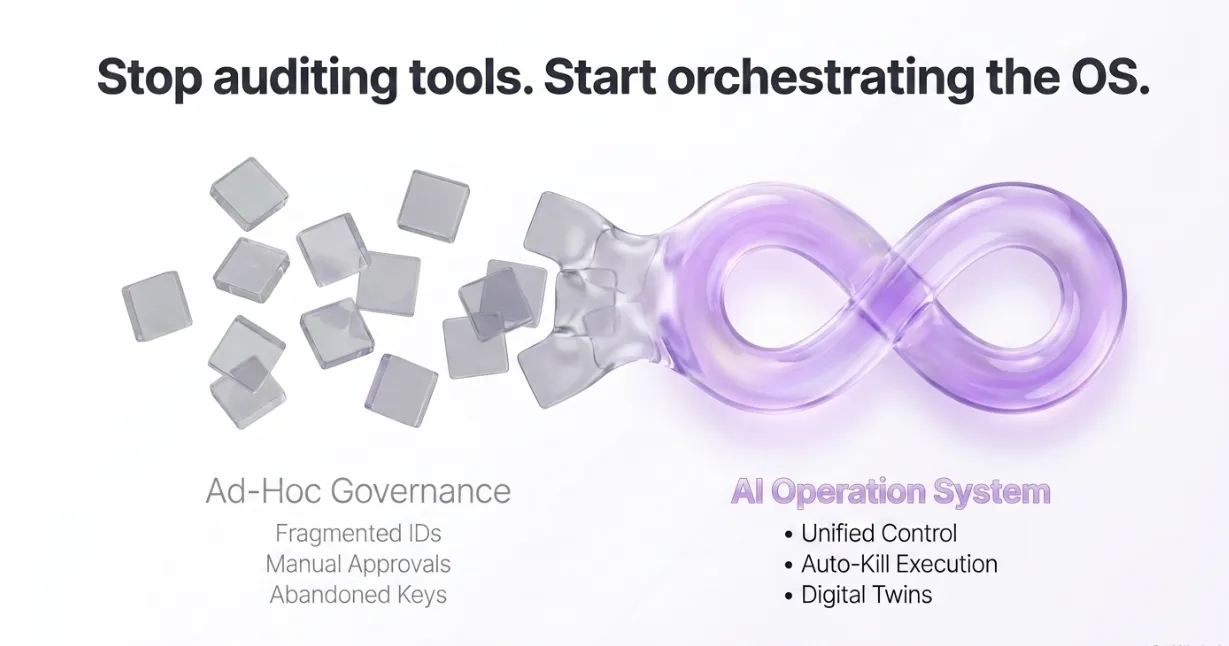
Rather than adding point solutions, design in three layers.
| Layer | Purpose | What to decide |
|---|---|---|
| Visibility | Know what is running | Agent inventory, human owners, autonomy level classification |
| Control | Stop dangerous behavior | Least privilege, runtime authorization, halt and recovery procedures |
| Sustain & evolve | Update without degrading quality | Decision reproducibility, knowledge freshness, human oversight design |
Most organizations skip visibility and control and try to solve everything with human approval. That produces approval fatigue and turns governance into a formality.
Control should also be proportional, not uniform. Applying the same rules to a read-only agent and an autonomous write-capable agent either hobbles the former or leaves the latter dangerous.
7. Our Answer: Aezisai's AIOS Platform
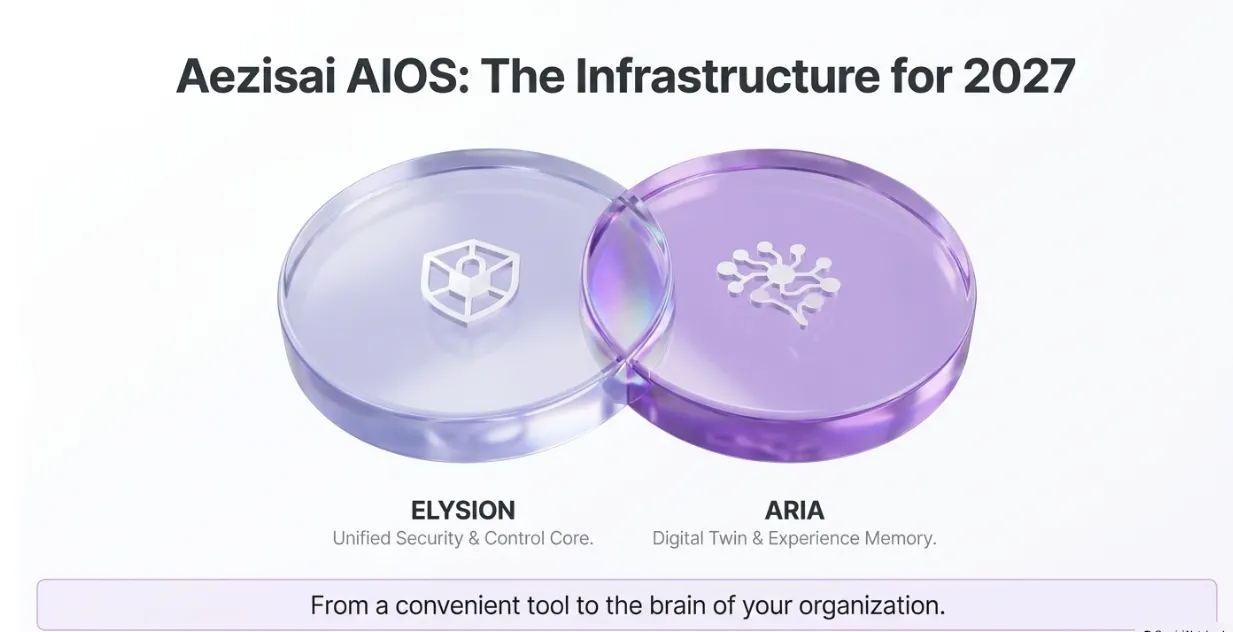
What we are building is not a standalone AI tool but Aezisai's AIOS platform. Rather than assembling features, we design identity, permissions, audit, halt capability, and evolution as one architecture. At its core sit ELYSION, the unified security and control plane, and ARIA, a digital twin AI that accumulates experience and judgment criteria.
7-1. ELYSION: Unified Security and Control Plane
ELYSION is the unified security and control plane for our AI product family. Its founding idea is "from control to a connected economic foundation, with AI as the premise." It centralizes secure sign-in, access permissions, audit logs, and contracts and billing, then extends that trust foundation to AI product composition and partner integration.
| Step | Detail | |
|---|---|---|
| **STEP 1 \ | The trust foundation** | Sign in to every product with a single identity. Centralize access permissions, audit logs, and contracts/billing. |
| **STEP 2 \ | The evolution of a personal digital twin** | An agent that continuously learns an individual's experience and judgment criteria on their own device. Confidential data never leaves; work happens in an isolated execution space and disappears on completion. |
| **STEP 3 \ | Organizational assetization and specialist AI** | Individual insight is aggregated into company-wide knowledge as an asset, with tamper protection. Specialist AIs — PROMETIA (development), ARTHEA (business execution), THEMIS (quality and governance) — then autonomously handle departmental operations. |
7-2. ARIA: A Digital Twin AI That Accumulates Experience and Judgment Criteria
ARIA is a digital twin AI that accumulates an organization's experience and judgment criteria. Rather than treating AI as a productivity tool, it continuously converts judgment heuristics that would otherwise remain tacit and personal into reusable organizational assets. It implements a self-learning loop that structures and stores experience, plus distributed learning through P2P semantic exchange.
| Component | Role |
|---|---|
| Local-first core | Runs in the user's local environment without surrendering data to the cloud. Extracts success and failure patterns from daily work and evolves autonomously as a digital twin. |
| Aria Git | Version-controls the semantics of business logic and structured data, not text diffs. When humans and AI conflict, it proposes a merge that preserves intent. |
| Satellite orchestration | ARIA is not a chat interface but an integration hub. It loads Arthea, Prometia, and Themis as add-ons and executes business processes inside isolated sandboxes. |
7-3. Execution Governance and Normative Connection
AI safety cannot be guaranteed by writing rules in advance. The essential question is whether you can govern at the moment of execution.
We therefore adopt self-annihilating containers built on the principle that disposability is security. An approval gate prevents unapproved work from leaving, while autonomous halting and immediate erasure of dangerous executions enforce safe, closed-domain operation. The execution environment does not persist. What remains is only the approved output and its record, measured against the norm.
7-4. Cronias: An AI Ecosystem
ELYSION, ARIA, ARTHEA, PROMETIA, and THEMIS form a single AI ecosystem under the technology brand Cronias. Within it, ARIA is the essential starting point.
Experience and judgment criteria cultivated on the device accumulate into organizational assets through ELYSION's trust foundation, and on that foundation PROMETIA (development), ARTHEA (business execution), and THEMIS (quality and governance) operate. This is not a collection of tools but an ecosystem in which experience circulates.
7-5. Matching the Problems to Our Approach
| Problem raised in this article | How Aezisai's AIOS platform addresses it |
|---|---|
| Growth of rogue agents | ELYSION centralizes permissions and contracts per Tenant × Brand |
| Diffuse accountability | Unified identity registration and consolidated audit logs tie actions to identities |
| Orphaned credentials and data leakage | Local-first design: confidential data stays local, is processed in isolated execution spaces, and disappears on completion |
| Unapproved output leaving the boundary; dangerous execution | Execution governance and normative connection: self-annihilating containers, approval gates, autonomous halting and immediate erasure |
| Audit log overload and weak reproducibility | Aria Git version-controls semantic diffs, making decision intent traceable |
| Memory contamination and knowledge decay | Experience is structured, stored, and inherited as a digital twin, via self-learning loops and P2P semantic exchange |
| Erosion of human judgment | Individual experience and judgment criteria are cultivated as a digital twin and converted into organizational assets — designed so humans remain the subject of judgment |
Conclusion: From Convenient Tool to Organizational Infrastructure
The competitive axis for 2027 is not model performance. It is whether you have an operating system for AI.
- Can you stop it? You have halt and recovery procedures.
- Can you explain it? You can reproduce the decision path, and accountability is named.
- Can you forget? You can retire outdated knowledge.
- Can you avoid weakening people? You preserve exception-handling skill and the quality of approvals.
What we are aiming for is not an AI agent that returns chat on a human's behalf. It is to hold safely everything an organization accumulates — know-how, success patterns, rules, and the transitions between states — so that even a new member can deliver top-quality work from day one. That is the sustainable infrastructure that becomes the organization's brain.
FAQ
Q. Where should we start? A. Build an agent inventory and assign a named human owner to every agent. Gartner likewise lists establishing governance policy first and building a centralized agent inventory second.
Q. Why is a kill switch necessary? A. AI agents can behave unpredictably. Unless you can revoke access in a single action, your security organization cannot approve production operation.
Q. Should governance be uniformly strict? A. Uniform application fails. Control must vary by autonomy level. Uniform tightening simultaneously over-restricts simple agents and under-restricts autonomous ones.
Q. How should we handle shadow AI and rogue agents? A. Through control design, not prohibition. In Japan, 75% of enterprises permit unapproved generative AI use under certain conditions, while 73% cannot manage it adequately. Prioritize full inventory and owner assignment, and steer usage onto a safe path.
Q. What should we check before adopting a third-party AI agent service? A. Three things: whether permissions can be scoped down, whether delegation chains are traceable, and whether the agent can be stopped. Gartner estimates only about 130 of thousands of vendors are real, so judge on control design rather than feature demos.
Q. Since the EU deferred its rules, can we deprioritize compliance? A. Only conformity assessment for high-risk systems was deferred. Transparency obligations, GPAI obligations, and prohibited practices were not. The deferral is a preparation window, and compliance within the new deadlines remains mandatory.
Q. Can we extend our existing identity management? A. No. AI agents acquire permissions at runtime and delegate to other agents. Identity lifetimes are short, and static role-based management cannot trace them.
Q. What is Aezisai's AIOS platform? A. It is an AIOS platform built around ELYSION (unified security and control plane) and ARIA (a digital twin AI that accumulates experience and judgment criteria). Rather than a combination of standalone tools, it designs identity, permissions, audit, halt capability, and evolution as one architecture.
Q. What is the relationship between ELYSION and ARIA? A. ELYSION provides the trust and control foundation — unified identity, permissions, audit logs, and contracts. On that foundation, ARIA operates as a digital twin AI that accumulates experience and judgment criteria. ARIA is the essential starting point of Cronias, our AI ecosystem, and the structure is one in which individual growth compounds into organizational growth.
Q. Does confidential data leave the organization? A. ARIA is local-first: it runs in the user's local environment. Confidential data does not leave, work happens in an isolated execution space, and it disappears on completion.
Sources
- Gartner, "Over 40% of Agentic AI Projects Will Be Canceled by End of 2027" (June 25, 2025) — https://www.gartner.com/en/newsroom/press-releases/2025-06-25-gartner-predicts-over-40-percent-of-agentic-ai-projects-will-be-canceled-by-end-of-2027
- Gartner, "Six Steps to Manage AI Agent Sprawl" (April 28, 2026) — https://www.gartner.com/en/newsroom/press-releases/2026-04-28-gartner-identifies-six-steps-to-manage-artificial-intelligence-agent-sprawl
- Gartner, "Applying Uniform Governance Across AI Agents Will Lead to Enterprise AI Agent Failure" (May 26, 2026) — https://www.gartner.com/en/newsroom/press-releases/2026-05-26-gartner-says-applying-uniform-governance-across-ai-agents-will-lead-to-enterprise-ai-agent-failure
- Gartner, "Top Strategic Predictions for 2027 and Beyond" (September 15, 2026) — https://www.gartner.com/en/newsroom/press-releases/2026-09-15-gartner-unveils-top-strategic-predictions-for-2027-and-beyond
- Gartner Japan, "New Guidance for Japanese Enterprises on Addressing Shadow AI" (June 18, 2026) — https://www.gartner.co.jp/ja/newsroom/press-releases/pr-20260618-aibs-shadow-ai
- Okta, "AI Agents at Work 2026: Securing the Agentic Enterprise" (Apprize360 survey; 7 countries, 292 executives, 492 knowledge workers) — https://www.okta.com/newsroom/articles/ai-agents-at-work-2026-agentic-enterprise-security/
- Okta, "Identity Governance for AI Agents" — https://www.okta.com/blog/product-innovation/identity-governance-for-ai-agents/
- Cloud Security Alliance × Zenity, "Enterprise AI Security Starts with AI Agents" (April 15, 2026) — https://cloudsecurityalliance.org/artifacts/enterprise-ai-security-starts-with-ai-agents
- Cloud Security Alliance, "The Non-Human Identity Governance Vacuum" (May 2026) — https://labs.cloudsecurityalliance.org/research/csa-whitepaper-nonhuman-identity-agentic-ai-governance-v1-cs/
- Cloud Security Alliance, "EU AI Act High-Risk Deadline: Deferred, Not Cancelled" (August 2026) — https://labs.cloudsecurityalliance.org/research/csa-research-note-eu-ai-act-high-risk-deadline-omnibus-20260/
- IBM, "Cost of a Data Breach Report" — https://www.ibm.com/reports/data-breach
- Verizon, "Data Breach Investigations Report 2026" — https://www.verizon.com/business/resources/reports/dbir/
- CloudSEK, "LiteLLM AI Supply Chain Breach: 2,500+ Companies, 434,000 CI/CD Pipelines" — https://www.cloudsek.com/blog/ai-supply-chain-breach-2500-companies-434000-cicd-pipelines
- FBI, "Cyber Criminal Group TeamPCP," FLASH-20260702-01 (July 2, 2026) — https://www.fbi.gov/investigate/cyber/alerts/2026/cyber-criminal-group-teampcp
- Gravitee, "State of AI Agent Security" (April 2026) — https://www.gravitee.io/state-of-ai-agent-security
- Deloitte, "State of AI in the Enterprise 2026" — https://www.deloitte.com/us/en/what-we-do/capabilities/applied-artificial-intelligence/content/state-of-ai-in-the-enterprise.html
- EUR-Lex, "Regulation (EU) 2026/1744" — https://eur-lex.europa.eu/eli/reg/2026/1744/oj/eng
- NIST, "AI Risk Management Framework" — https://www.nist.gov/itl/ai-risk-management-framework
- World Economic Forum, "Non-human identities: Agentic AI's new frontier of cybersecurity risk" — https://www.weforum.org/stories/cybersecurity/non-human-identities-ai-cybersecurity/
- e-Gov, "Act on Promotion of Research, Development and Utilization of AI-Related Technologies" (Act No. 53 of 2025) — https://laws.e-gov.go.jp/law/507AC0000000053