Why AI Agents Never Reach Production: The PoC "Valley of Death" and Its 16 Failure Modes
Summary
- The AI agent market is forecast to grow from $10.9 billion in 2026 to $182.9 billion in 2033, a CAGR of 49.6% (Grand View Research).
- Meanwhile, 95% of enterprise generative AI pilots deliver no measurable business results (MIT NANDA), and more than 80% of AI projects fail — roughly twice the failure rate of non-AI IT projects (RAND Corporation).
- This gap is what this article calls the AI agent Valley of Death: passing a PoC and surviving production are two different capabilities.
- The failure modes split into two layers: 8 structural failure modes (contracts, organization, governance) and 8 technical failure modes (operations, security, cost). The root disease sits mostly in the structural layer.
- This article provides a 10-point self-assessment to determine whether your project is already inside the Valley, and a six-domain design blueprint for crossing it.
1. A market set to grow 16x in seven years — while more than 80% of AI projects fail
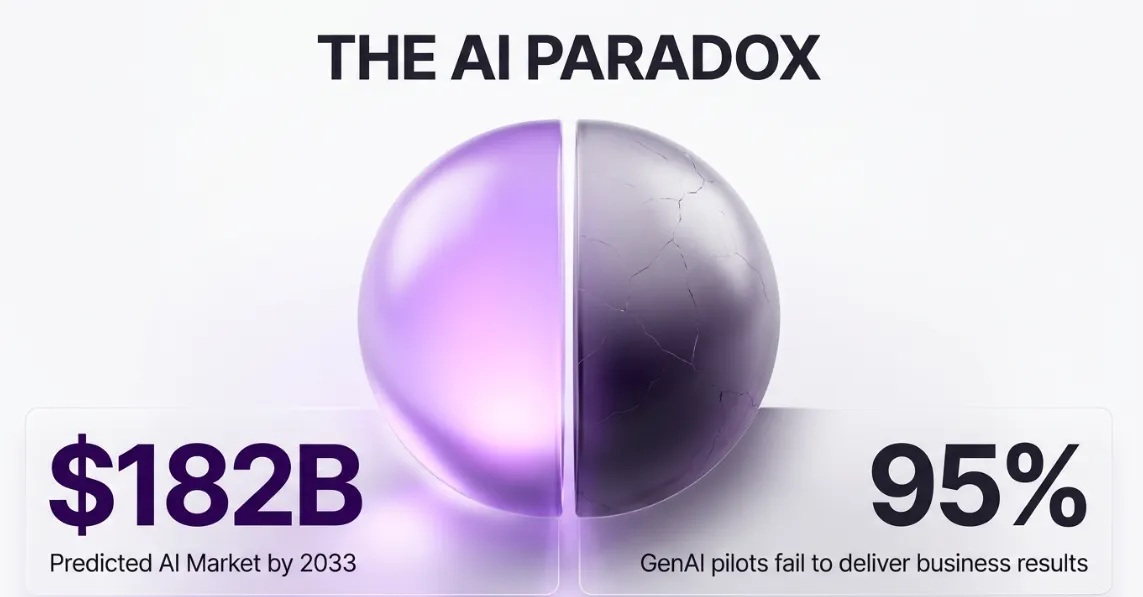
The AI agent market is expanding rapidly. According to Grand View Research, the market is expected to grow from $10.9 billion in 2026 to $182.9 billion in 2033, at a compound annual growth rate (CAGR) of 49.6% (Grand View Research). According to Gartner, by the end of 2026, 40% of enterprise applications will feature integrated task-specific AI agents. The firm further predicts that by 2028, at least 15% of day-to-day work decisions will be made autonomously through agentic AI (Gartner).
On the ground, however, the reality is the opposite. MIT Project NANDA's research report, The State of AI in Business 2025, found that 95% of enterprise generative AI pilots deliver no measurable P&L impact (MIT NANDA). RAND Corporation's study, The Root Causes of Failure for AI Projects, cites estimates that more than 80% of AI projects fail — about twice the failure rate of IT projects that do not involve AI (RAND Corporation). In the same report, 84% of interviewed practitioners identified leadership-driven failure patterns — such as optimizing for the wrong business problem — as the primary cause of project failure.
Gartner predicts that over 40% of agentic AI projects will be scrapped by the end of 2027. The leading reasons: escalating costs, unclear business value, and inadequate risk controls. The firm additionally predicts that by 2027, 40% of enterprises will demote or decommission autonomous AI agents due to governance gaps that only surface after production incidents (Gartner).
| Metric | Value | Source |
|---|---|---|
| AI agent market size (2026) | $10.9B | Grand View Research |
| Same (2033) | $182.9B (CAGR 49.6%) | Grand View Research |
| Enterprise apps with embedded AI agents (end of 2026) | 40% | Gartner |
| Generative AI pilots with no measurable business results | 95% | MIT NANDA |
| AI projects that fail | 80%+ (~2x non-AI IT projects) | RAND Corporation |
| Agentic AI projects canceled by end of 2027 | 40%+ | Gartner |
| Enterprises demoting/decommissioning agents by 2027 | 40% (governance gaps found in production) | Gartner |
In short, market explosion and field-level stagnation are happening at the same time. That gap is exactly what AI adopters are facing: the "Valley of Death."
2. What the AI agent Valley of Death is — the gap between passing a PoC and surviving production
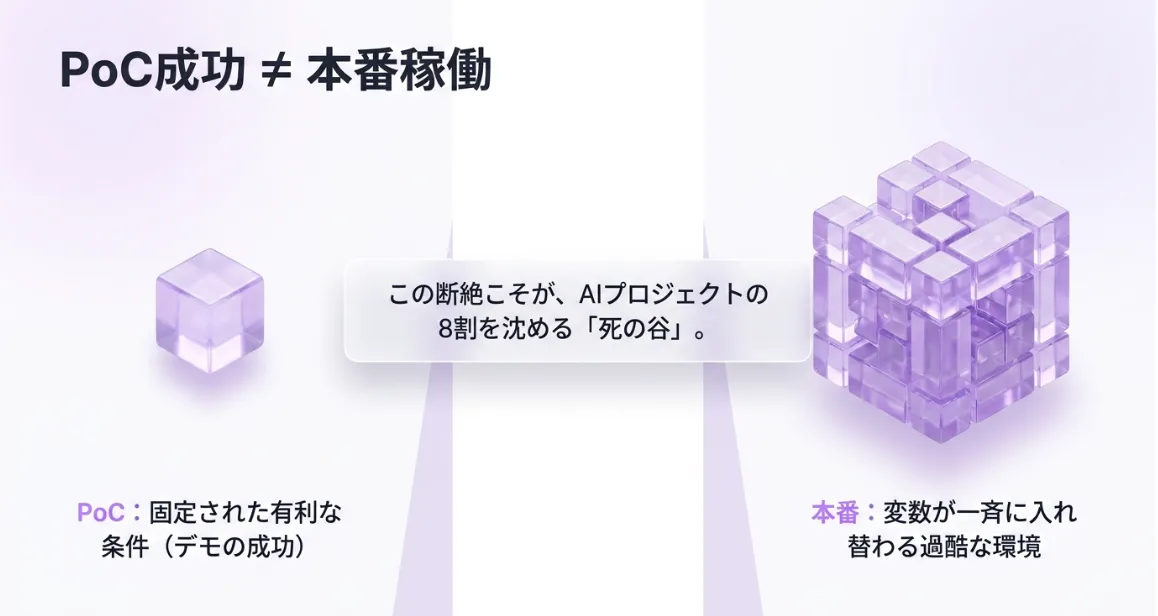
The AI agent Valley of Death is the structural gap in which AI projects that pass proof of concept (PoC) stall or die during the transition to production and scale.
Loading diagram…
Figure 1: The AI agent Valley of Death. Most projects sink at the transition point after passing PoC.
The critical property of the Valley is that passing a PoC and running reliably in production are different kinds of capability. A passed PoC is a success under deliberately favorable, fixed conditions. During the move to production, every variable switches at once.
| Dimension | PoC environment | Production environment |
|---|---|---|
| Data | Curated, cleaned, limited data | Raw, org-wide data full of duplication, conflict, and noise |
| Users | A small, willing group of insiders | All employees, including resisters |
| Operations | Heavy manual support | Unattended, always-on |
| Blast radius of failure | Retryable within the team | Business interruption and loss of field trust |
| Cost structure | Small and mostly fixed | Token spend scales with usage |
| Definition of success | "The demo worked" | ROI, SLAs, auditability |
The Valley of Death is therefore a transition point where every variable flips at once. PoC success stories are not just useless in production — they become a source of overconfidence. The failure modes blocking this transition split into two layers.
| Layer | Nature | Primary owner | Type of response |
|---|---|---|---|
| Structural failure modes (8) | Root causes in organization, contracts, governance | Executives (CXO/CDO/CISO/legal) | Organizational redesign, contract restructuring |
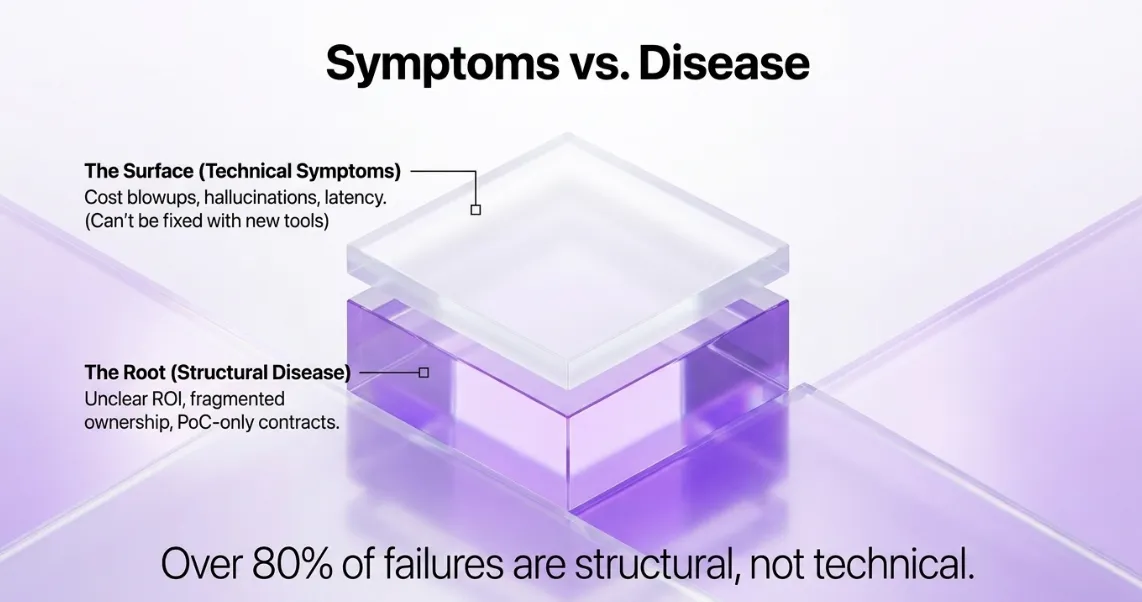
| Technical failure modes (8) | Surface symptoms in operations, security, cost | Field teams (SRE/EM/QA) | Sustained operational practices |
The majority of failures trace back to the structural layer. This means swapping tools will not get you across the Valley.
Loading diagram…
Figure 2: The disease–symptom loop. Technical quick fixes only suppress symptoms; as long as the structural disease remains, failures recur.
3. Structural failure modes — the 8 root causes living in the organization
Structural failure modes are root causes embedded in organizational systems, contracts, and role design. Piling technical countermeasures on top without treating them only guarantees recurrence.
| # | Failure mode | Root cause (the disease) | Typical symptoms |
|---|---|---|---|
| 1 | PoC-only contracting | The vendor's responsibility ends at delivery; no contract structure carries accountability through to production | PoC and demos succeed, but everyone walks away when scaling to production begins. "The previous three vendors all failed" comes up repeatedly |
| 2 | Organizational fragmentation and talent gaps | The separation of field teams, IT, and management leaves no owner; planning and implementation sit in different organizations | "Who is responsible?" gets re-asked every time, and decisions stall |
| 3 | No evaluation framework | ROI is undefined, and PoC success is judged solely by "the demo worked" | No numbers survive into management reporting; not even last year's PoC count is known |
| 4 | Overpromising | "It can do anything" sales pitches versus limited autonomy in real operations | The demo-to-production accuracy gap destroys field trust, and rollout stops immediately |
| 5 | Missing data foundations | Department-specific databases, duplicated and contradictory, poison the learning soil | The PoC passes on curated data; production noise collapses accuracy |
| 6 | Absent governance ownership | Management responsibility unsettled among CIO, CDO, and CISO | When an incident hits, departments claim "not my jurisdiction"; no runbook or reporting line exists |
| 7 | Unattended AI agents | No register, owner, or handover procedure; agents beyond management handle data outside controls | Departments mass-produce agents while the IT department has no view of the reality |
| 8 | Missing change management | Success depends more on field acceptance (change management) than on technical skill | Manager-level obstruction and private workarounds spread; usage never sticks |
Countermeasures for structural failure modes are put in place through contract and organizational design after the PoC ends and before implementation moves to production: writing operational accountability into the contract, documenting promotion criteria (graduation thresholds) and ROI in month one, running a data-health assessment before full implementation, and fixing the AI governance owner and incident procedures first. Whether this order is honored determines how effective the later technical countermeasures will be.
4. Technical failure modes — the 8 symptoms that surface in operations
Technical failure modes are symptoms that surface in production operations. Field engineering teams can address them continuously — but if the structural failure modes are left untreated, they recur permanently.
| # | Failure mode | Root cause | Typical symptom |
|---|---|---|---|
| 9 | Orchestration explosion | Growing agent counts make the state space and recovery paths explode exponentially | A single request chains many API calls, and pipelines readily stall or deadlock |
| 10 | Zero observability and auditability | No execution logs are recorded | After an outage, agent behavior cannot be reconstructed and the cause of wrong answers cannot be identified |
| 11 | Cost explosion | Moving to production multiplies token consumption, and budgets balloon | Unexpected invoices reach accounting, and the budget is frozen |
| 12 | Hallucination-driven trust collapse | A single wrong answer stops field usage and makes the investment unrecoverable | Usage plummets right after launch, and approvals freeze |
| 13 | Security boundary breaches | Prompt injection and privilege escalation via integrations | Unauthorized access through production agents shows up in logs |
| 14 | Vendor lock-in | Dependence on a specific model or API turns spec changes and deprecation into full outages | A provider deprecation silences the system |
| 15 | Latency and timeouts | Chained agents push total response time into tens of seconds | Field tolerance (seconds) is exceeded, and work falls back to manual |
| 16 | Version compatibility collapse | Upstream model, SDK, and framework updates break dependencies | A single dependency update causes a production outage |
Technical failure modes can be managed by turning countermeasures into sustained routines: monitoring with rollback, execution logs with audit trails, token spend caps, automated response validation, and regression testing of dependencies — each built into monthly operations. Note that the EU AI Act is being applied in stages (prohibitions from February 2025, most remaining provisions from August 2026), and the core obligations for high-risk AI systems classified in Annex III apply from December 2, 2027, following the Digital Omnibus deferral. High-risk systems must be capable of automatically logging events during operation — observability is shifting from a quality concern to a legal requirement.
5. Self-assessment: is your project already inside the Valley?
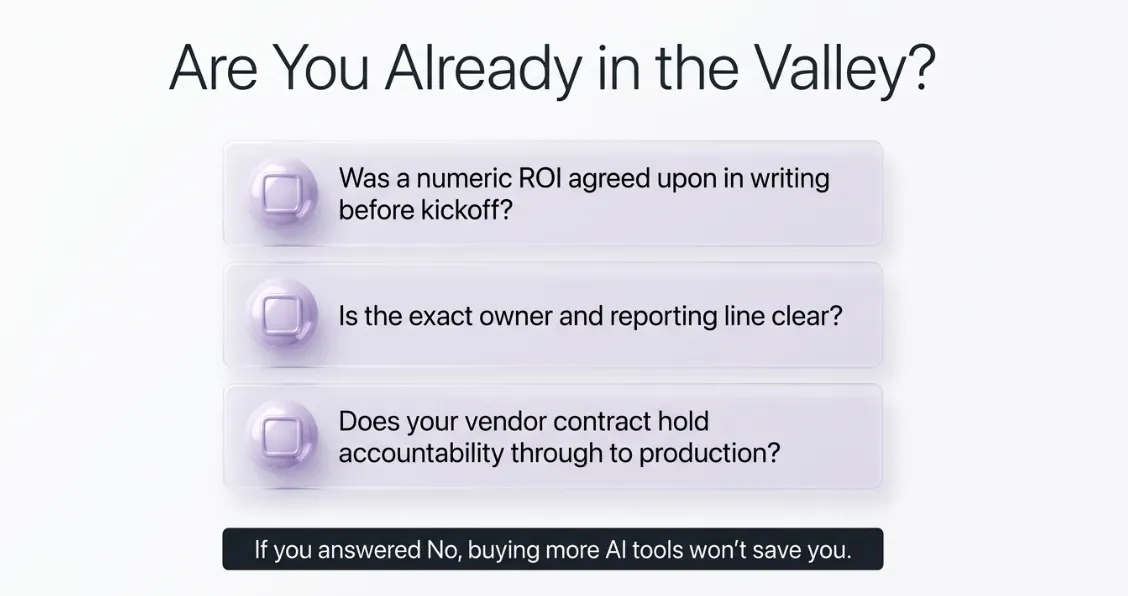
The Valley is hard to detect from the inside. The PoC passed, the demo works, the deck count keeps growing. That is why the warning signs must be caught in words before numbers. If three or more of the following ten statements are true, treat your project as already inside the Valley.
| # | Self-check item | Failure mode to suspect (layer) |
|---|---|---|
| 1 | No numeric success target for the AI initiative was agreed in writing at kickoff | No evaluation framework (structural) |
| 2 | The owner and reporting line are vague, and "who decides" changes meeting to meeting | Organizational fragmentation (structural) |
| 3 | The contract says nothing about the vendor's accountability up to production | PoC-only contracting (structural) |
| 4 | The vendor proposal contains no "what we will NOT do" list | Overpromising (structural) |
| 5 | Customer masters or core databases differ across departments | Missing data foundations (structural) |
| 6 | No contact or procedure is defined for when the AI errs or an incident occurs | Absent governance ownership (structural) |
| 7 | AI agents built by departments run without a central register | Unattended AI agents (structural) |
| 8 | Over half of field-survey responses oppose AI adoption | Missing change management (structural) |
| 9 | No department can state last month's AI spend on the spot | Cost explosion (technical) |
| 10 | After an incident, no one can explain the agent's decision trail from logs | Zero observability (technical) |
The more boxes you tick, the more your next move is positioning, not procurement. Buying more tools inside the Valley does not help if the direction is wrong.
6. Crossing the Valley: what to decide before moving from PoC to production
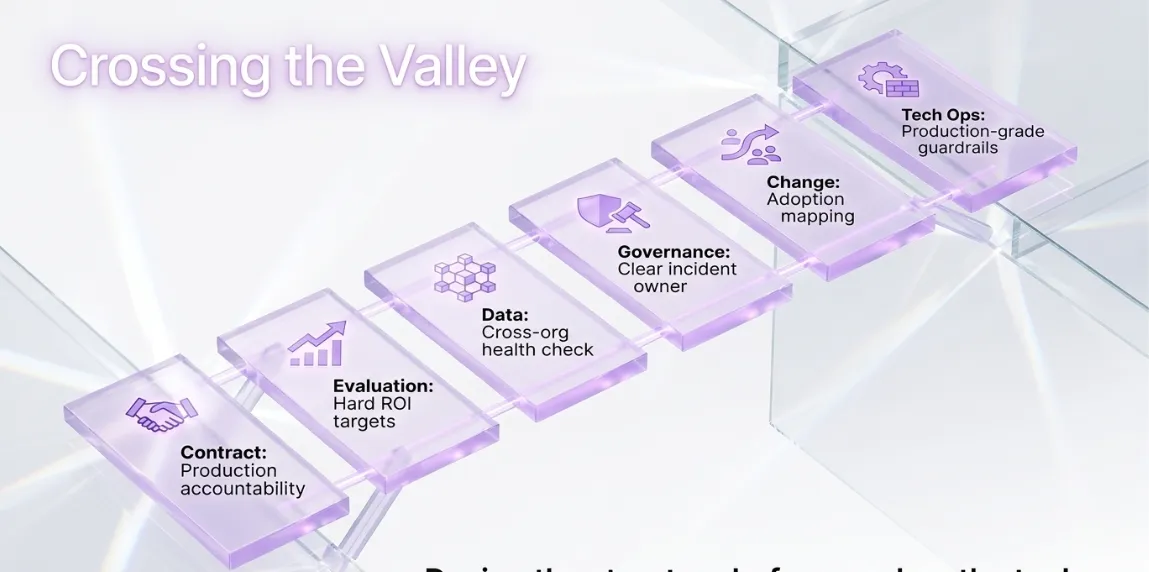
Distilling the lessons into practice for adopters, six domains must be designed before a project moves from PoC to production.
| Domain | Valley-proof design | What to verify before production |
|---|---|---|
| Contract | Vendor accountability up to production, in writing | Is "reaching production" defined, with ownership assigned, in the contract text? |
| Evaluation | PoC graduation criteria documented in month one; ROI defined | Is the PoC-to-production promotion threshold agreed numerically? |
| Data | Data-health assessment before full implementation | Have cross-department data conflicts been detected and resolved? |
| Governance | AI owner and incident procedures fixed first | Are reporting lines and runbooks documented? |
| Change management | Field interviews and adoption design built into the rollout | Is the true source of resistance being logged and addressed? |
| Technical operations | Monitoring, auto-validation, spend caps, dependency management as monthly routine | Are these mechanisms designed for production, not for the PoC? |
Structural failure modes belong to executives; technical failure modes belong to the field. Both are caught by the same entrance — a diagnostic that makes the failure modes visible — and closed by contracts and evaluation frameworks that carry accountability all the way to production. That sequence itself is the design for crossing the Valley.
Loading diagram…
Figure 3: The sequence for crossing the Valley. Diagnose first, fix the five design domains, then build technical operations on production assumptions.
7. Core Takeaways
The conclusions of this article are threefold.
- Market explosion and field stagnation coexist. The AI agent market will grow ~16x by 2033, yet 95% of generative AI pilots deliver no measurable results (MIT NANDA) and more than 80% of AI projects fail (RAND Corporation).
- The disease is structural, not technical. Half of the 16 failure modes — missing production accountability in contracts, no owner, undefined ROI, absent governance — cannot be fixed by switching tools.
- The dividing line is whether production accountability is built into contracts and evaluation frameworks at the moment a project moves from PoC to production. Only adoption paths that start with a diagnostic and carry accountability to production can close the gap between passing a PoC and surviving production.
8. FAQ
Q1. What is the "AI agent Valley of Death"?
The structural gap in which AI projects that pass proof of concept (PoC) stall or get canceled during the transition to production and scale. While the market is expanding rapidly, 95% of generative AI pilots deliver no measurable business results (MIT NANDA) and more than 80% of AI projects fail (RAND Corporation) — market boom and field stagnation are happening simultaneously.
Q2. What is the biggest reason AI agent PoCs never reach production?
Organizational structure, not technology. In this article's classification, the 8 structural failure modes (missing production accountability in contracts, no owner, undefined ROI, absent governance) account for most of the disease. Tool selection or replacement alone does not fix this; contracts and organizational design must change.
Q3. What is the forecast for the AI agent market?
Grand View Research projects the market will grow from $10.9 billion in 2026 to $182.9 billion in 2033, at a CAGR of 49.6%. Gartner predicts that 40% of enterprise applications will feature task-specific AI agents by the end of 2026, while also predicting that over 40% of agentic AI projects will be canceled by the end of 2027 and that by 2027, 40% of enterprises will demote or decommission AI agents over governance gaps — expansion and shakeout are proceeding simultaneously.
Q4. How can I tell whether my AI project is already in the Valley of Death?
Use the 10-point self-assessment in Chapter 5. If three or more items apply — no agreed numeric target, unclear ownership, no production accountability in the contract — the project is likely inside the Valley, and structural redesign should come before buying more tools.
Q5. What is the difference between structural and technical failure modes?
Structural failure modes are root causes in organization, contracts, and governance, addressed by executives through decisions and redesign. Technical failure modes are surface symptoms in operations, security, and cost, addressed by SRE and engineering teams through sustained operations. Fixing only the technical layer guarantees recurrence as long as the structural layer remains — which is why separating the two comes first.
Q6. What should an enterprise do first when adopting AI agents?
Run a diagnostic assessment that makes the current state visible: data health, audit logging, governance structure, and unmanaged AI agents. Confirming the failure modes before full implementation helps avoid the cancellation pattern Gartner predicts — escalating costs and unclear value.
Sources (primary)
- Grand View Research, "AI Agents Market Size, Share And Trends Report, 2026-2033" — https://www.grandviewresearch.com/industry-analysis/ai-agents-market-report
- MIT Project NANDA, "The State of AI in Business 2025" (2025) — https://nanda.media.mit.edu/ai_report_2025.pdf
- RAND Corporation, "The Root Causes of Failure for AI Projects and How They Can Succeed" (2024, RR-A2680-1) — https://www.rand.org/pubs/research_reports/RRA2680-1.html
- Gartner press release, "Gartner Predicts 40% of Enterprise Apps Will Feature Task-Specific AI Agents by 2026" (August 26, 2025)
- Gartner press release, "Gartner: Over 40% of Agentic AI Projects Will Be Canceled by End of 2027" (June 25, 2025)
- Gartner press release, "Gartner Says Applying Uniform Governance Across AI Agents Will Lead to Enterprise AI Agent Failure" (May 26, 2026)
- IBM, "Cost of a Data Breach Report 2025" — https://www.ibm.com/reports/data-breach
- EU AI Act Implementation Timeline (Future of Life Institute, updated August 31, 2026) — https://artificialintelligenceact.eu/implementation-timeline/
- Fortune, "MIT report: 95% of generative AI pilots at companies are failing" (August 18, 2025; interview with the report's lead author) — https://fortune.com/2025/08/18/mit-report-95-percent-generative-ai-pilots-at-companies-failing-cfo/