Why Cognitive Infrastructure is the Next Step Beyond AI-Native
Summary
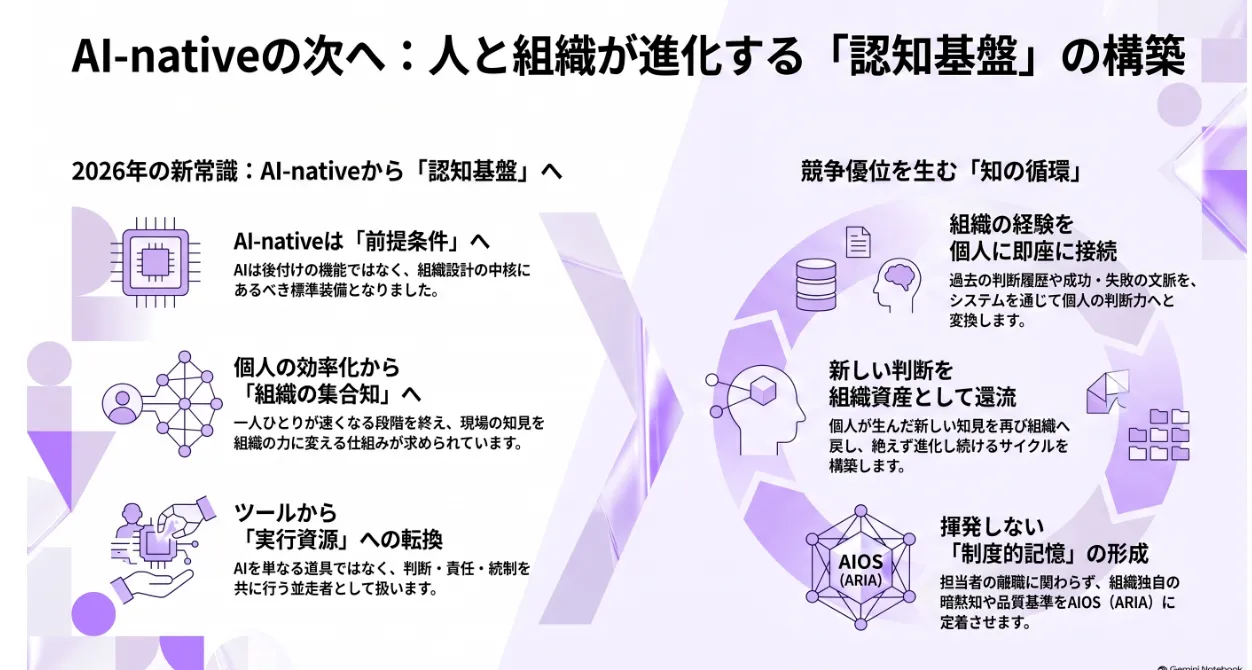
- In 2026, AI-native became table stakes.
- The debate over "making AI core rather than bolted on" is already over.
- IBM's definition, Deloitte's "The Great Rebuild," and ServiceNow's AI-native pricing tiers are the evidence.
- But the real question lies beyond that point.
- The destination is not "an organization that works faster with AI."
- It is a state in which AI functions as the organization's cognitive infrastructure, and people and the organization evolve together.
- What creates competitive advantage is the circulation of knowledge.
- Connect the organization's experience, the decision histories of others, and the context of successes and failures directly to the individual.
- Return the new decisions arising from that connection to the organization as an asset.
- Making this circulation itself the foundation is the core of the shift.
- What results is an expansion of the capability structure itself.
- Inheritable intelligence raises each individual's judgment, execution, and reproducibility.
- This is not one-off task support, but a continuous conversion of organizational knowledge into individual capability.
Note: This article is based on primary sources available as of September 24, 2026. Latest developments will be covered in separate articles as they arise.
What Is AI-Native? — In 2026, It Is Table Stakes
September 2026. The term "AI-native" is no longer a new concept.
In February, IBM defined it as follows: "something designed from the ground up with AI as a core component, not bolted on later as a mere feature."
Around the same time, Deloitte named this shift "The Great Rebuild" in its annual Tech Trends 2026 report. In April, ServiceNow replaced its entire pricing structure with "AI-native tiers" (Foundation, Advanced, and Prime). In Japan, AI NATIVE EXPO 2026 was held at Makuhari Messe in June, and on September 15–16 a conference took place under the theme "the essentials of building an AI-native organization."
Which brings us to this point.
The debate over making AI core rather than bolted on is over. It has become table stakes.
But there is no reason to stop there. If anything, the question lies beyond it.
What Is True AI-Native? — Treating AI as an Execution Resource
What, then, is true AI-native as we define it?
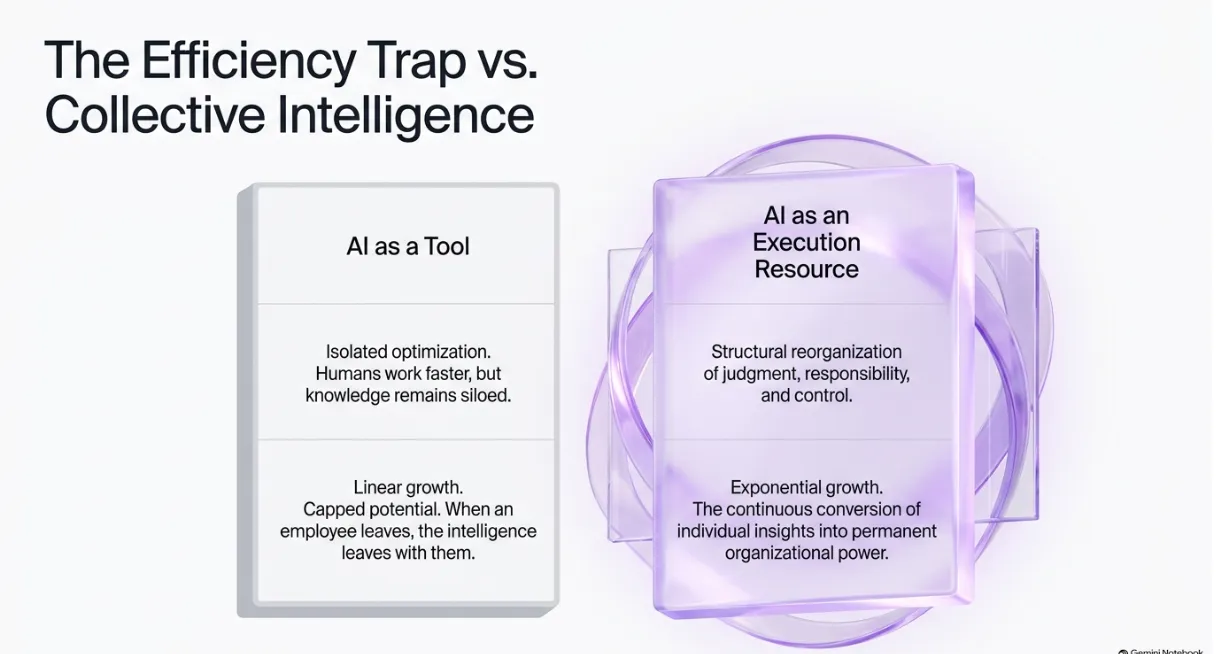
It is the state of treating AI not as a mere tool, but as an execution resource that works alongside people every day.
Work that once required a large team can move forward with far fewer people. What matters here is not eliminating human work. It is restructuring from the ground up how judgment, responsibility, and control are allocated. The organization's speed, density, and reach themselves change — only at this point have you reached the entrance to AI-native.
Yet even an organization that has reached this level is still not far enough.
Why Is "Individual Efficiency" Not Enough? — Toward Organization-Wide Collective Intelligence
The 2026 conversation has already moved to the next stage.
Salesforce offered this outlook among its predictions for 2026:
"With the rise of the 'AI-native engineer,' software development will be fundamentally redefined, evolving beyond individual productivity toward the collective intelligence of the entire organization."
In a keynote by its Japan division, the company added: "For engineers to exercise their creativity to the fullest and truly contribute to customers, there needs to be a mechanism that turns field insights into organizational strength."
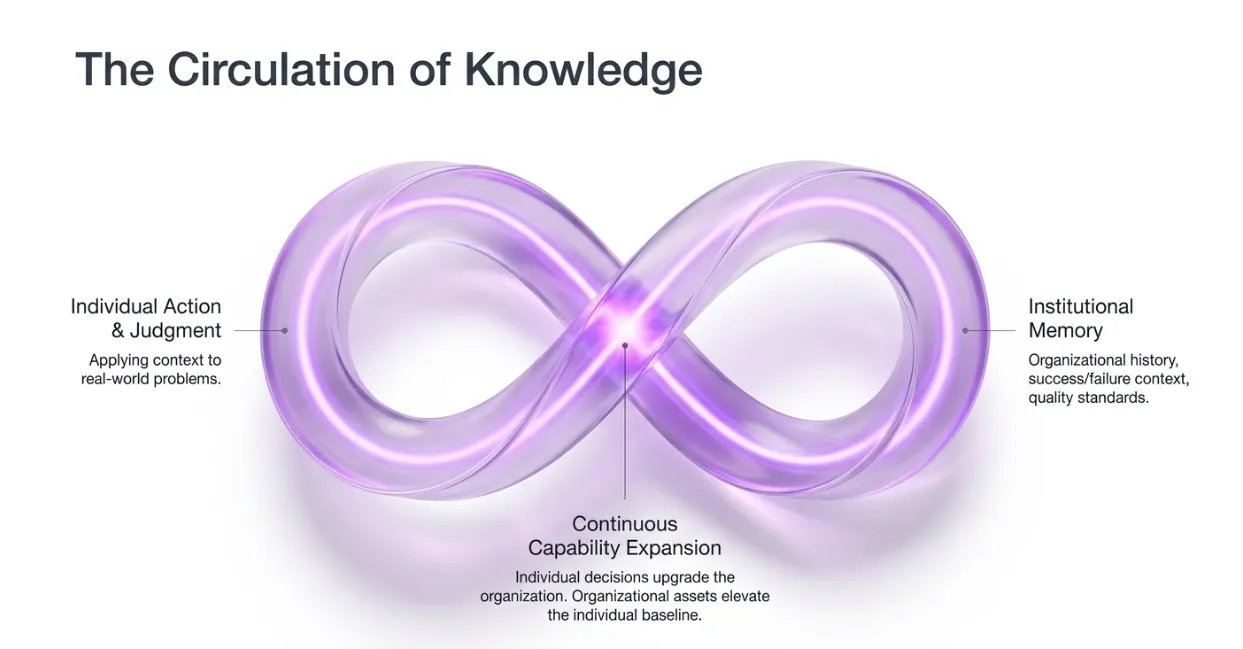
In other words, the frontier is not about "each person getting faster with AI." It is about a circulation in which insights generated in the field are converted into organizational strength and then returned to the individual.
That circulation is precisely what creates decisive competitive advantage. The organization's accumulated experience, the decision histories of others, and the context of successes and failures are connected to the individual instantly, through the system. And the new individual judgments arising from that connection are returned to the organization as assets.
What is happening here is not one-off task support.
Inheritable intelligence raises each individual's judgment, execution, and reproducibility — an expansion of the capability structure itself.
What Is "Cognitive Infrastructure"? — A Redefinition of the Learning Organization for the AI Era
In this sense, what lies beyond AI-native is not "an organization that works faster with AI."
It is a state in which AI does not exist as a convenient external function, but functions as the organization's cognitive infrastructure, allowing people and the organization to keep evolving together.
This can be described as a redefinition, for the AI era, of the "learning organization" proposed by Peter Senge. He introduced the concept to the world in his 1990 book The Fifth Discipline, and in the March 2026 issue of DHBR he himself discusses how the learning organization should evolve in the age of AI.
From an organization where only humans learn, to an organization where humans and AI continue learning on the same foundation. The answer to that question is AI as cognitive infrastructure.
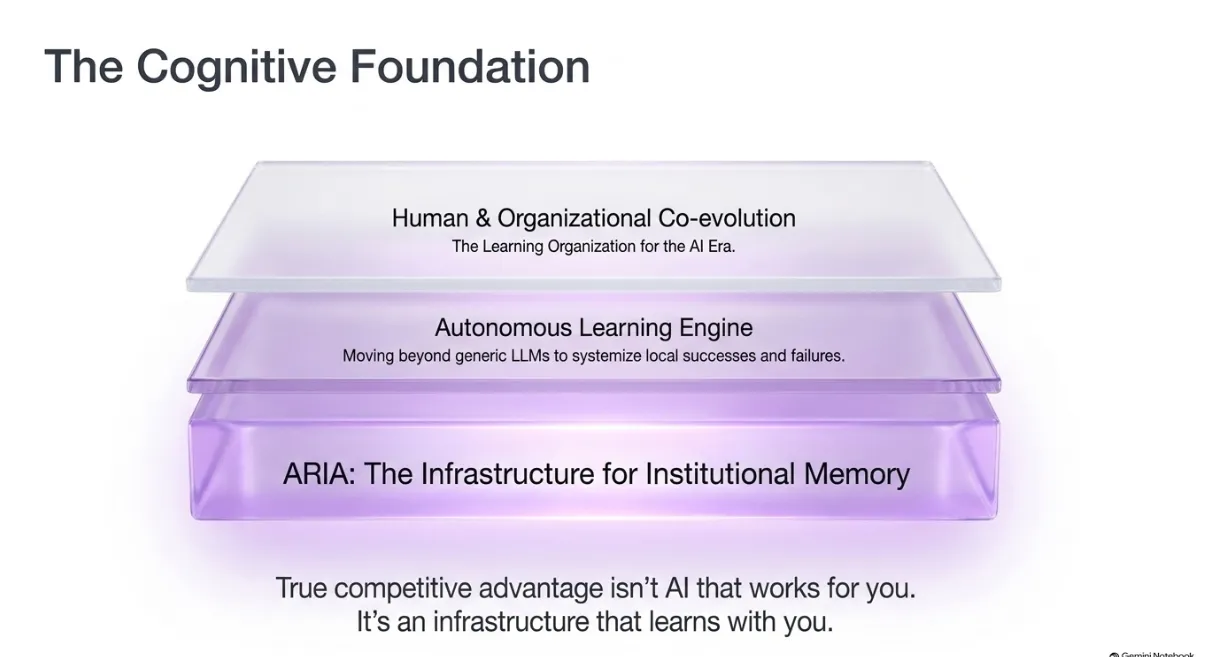
This is the stage that our autonomous AIOS, "ARIA," aims for. ARIA was designed not as a mere efficiency tool, but as cognitive infrastructure for people and organizations to evolve together.
Its foundation is a departure from general-purpose models.
Departing from General-Purpose Models — The Autonomous Learning Engine
Rather than using a giant model as-is, ARIA autonomously learns the options best suited to the organization from the successes and failures that occur in the field.
It establishes tacit knowledge — "the way we phrase things," "our quality standards" — within the system, turning daily judgment into institutional memory that does not evaporate. When a person transfers or leaves, that intelligence remains with the organization.
This design exists so that collective intelligence does not end as a slogan. Insights alone do not become an asset. They must accumulate with every decision and return in a form that improves the next one — only then does collective intelligence actually function.
What Is the Typical Pattern of AI Adoption Failure?
In 2026, companies that claim to be AI-native are hardly rare. Yet most of them are still stuck at the stage of "putting AI to work."
AI adoption that amounts to handing out tools hits a ceiling surprisingly fast. The models evolve every month while the organization's learning stands still — this is the most typical failure pattern.
What is needed is to connect organizational knowledge to the individual, return individual judgment to the organization as an asset, and make that circulation itself the foundation.
If AI-native means "an organization that puts AI to work," then the destination ARIA is heading toward is this:
An organization where AI and organizational knowledge expand individual capability, and people and the organization evolve together.
That is where the next generation of competitive advantage lies. We are building the infrastructure for it.
Frequently Asked Questions
Q. What is the difference between being AI-native and simply "having adopted AI"?
A. The difference is not whether AI is in use, but the design philosophy. AI-adopting organizations bolt AI onto existing processes; AI-native organizations place AI at the core and redesign their organizational structure, talent model, and approach to decision-making.
Q. Why is individual efficiency alone not enough for competitive advantage?
A. Because individual efficiency can be replicated by anyone, it rarely becomes a differentiator. Competitive advantage comes from a circulation in which organizational experience and decision histories connect instantly to the individual, and individual judgment accumulates again as an organizational asset.
Q. What exactly does "cognitive infrastructure" refer to?
A. It refers to a state in which AI does not exist as a convenient external function, but functions as the foundation that accumulates, connects, and circulates organizational knowledge. It is Peter Senge's "learning organization," extended into a form in which humans and AI learn on the same foundation.
Q. Which existing theories is this idea related to?
A. The closest theoretical lineage is Peter Senge's "learning organization" (1990, The Fifth Discipline). Salesforce's 2026 predictions also point in the same direction, with "evolving beyond individual productivity toward the collective intelligence of the entire organization."
References
- IBM, "What is AI native?" — https://www.ibm.com/think/topics/ai-native
- Salesforce, "The Future of AI Agents: Top Predictions and Trends to Watch in 2026" — https://www.salesforce.com/jp/news/stories/future-of-salesforce-2/
- AI NATIVE EXPO 2026 — https://www.ainative-expo.jp/2026/about/
- Impress, "'Impress AI Days 2026': Learn the Essentials of Building an AI-Native Organization" — https://dcross.impress.co.jp/docs/news/004824.html
- DIAMOND Harvard Business Review, "How the 'Learning Organization' Evolves in the Age of AI" — https://dhbr.diamond.jp/articles/-/13423