Escaping "Fixing AI": Building AIOS for Organizational Judgment

Summary
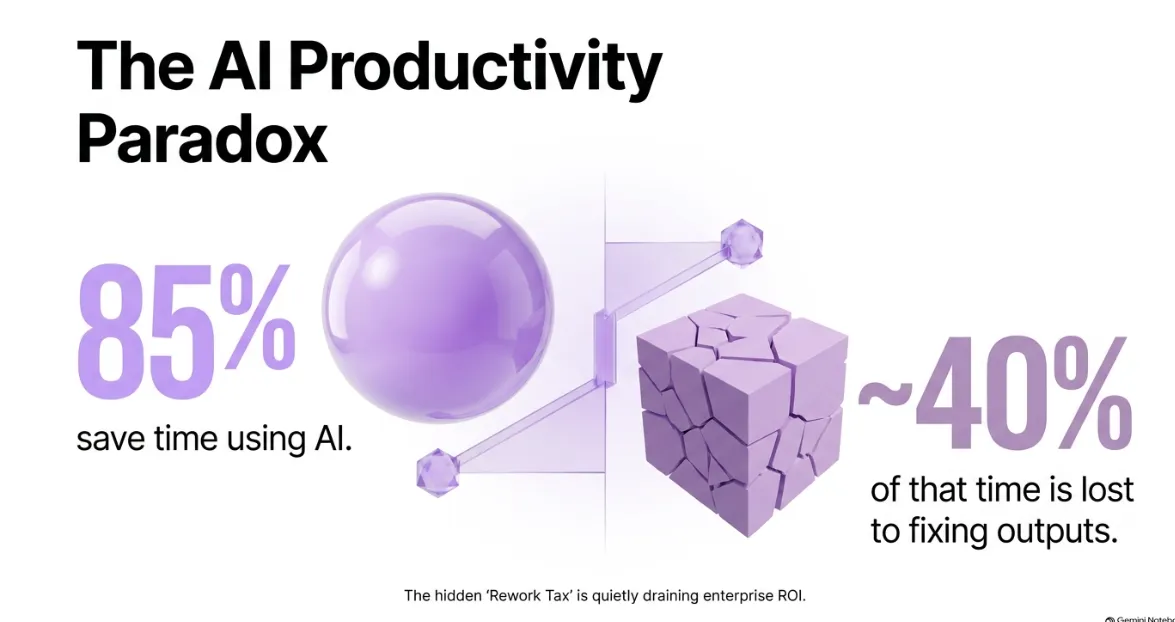
- AI does save time. But according to Workday's global study (January 2026, n=3,200), roughly 40% of the hours AI creates are lost again to editing, rewriting, and verifying its output.
- The cause is not weak AI models. It is the absence of a structural layer for encoding and storing organizational experience.
- The personal memory features everyone is racing to ship are a stopgap that optimizes an individual convenience. They do not generate organizational knowledge.
- In Japan, too, "turn tacit knowledge into organizational knowledge" is trending — but most efforts either retrain people or make documents searchable. Neither structures judgment as an asset.
- The real fix is a structure that keeps converting the crux of human judgment into reusable assets. That is what ARIA, the AIOS platform we are building, is designed for.
- Primary data (Databricks) shows the numbers reverse once memory is structured: reasoning steps per task drop from ~20 to ~5, and accuracy surpasses expert manual tuning. Rework tax is no longer removed by human effort — it is removed by structure.
This article is based on primary sources published as of September 16, 2026. Updates on newer developments will follow in separate posts.
1. The AI productivity paradox, in numbers
On January 14, 2026, Workday published Beyond Productivity: Measuring the Real Value of AI (fielded by Hanover Research in November 2025; 3,200 respondents across North America, APAC, and EMEA).
- 85% of employees report saving 1–7 hours a week with AI.
- Yet roughly 40% of that saving is lost to rework — correcting errors, rewriting content, and verifying output from one-size-fits-all tools.
- Only 14% of employees consistently achieve a positive net outcome.
- The heavier the usage, the heavier the burden: 77% review AI-generated work as carefully as human work, if not more.
- Of those carrying the most rework, about 46% are aged 25–34 — the cohort assumed to be the most tech-fluent is acting as the correction desk.
This is not a temporary phase. It is a structural problem that grows larger as agents spread.
2. The cause is not capability — it is missing memory structure
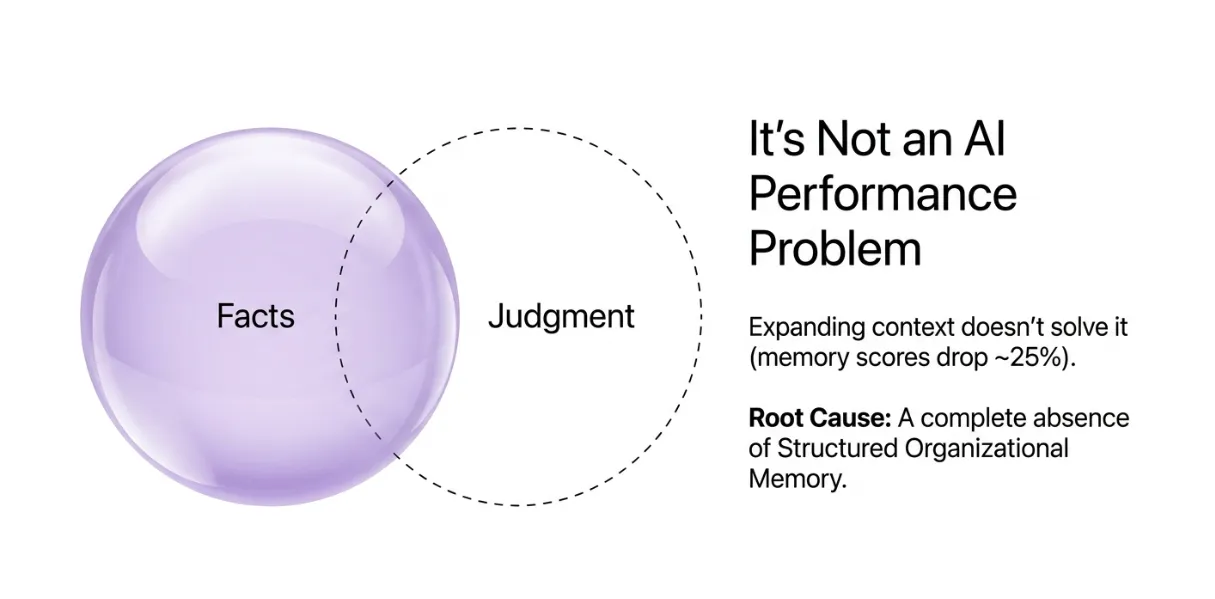
Why doesn't the organization's execution speed actually improve? Three reasons:
- Context dies with the session. In production agent systems, as much as 85% of compute goes toward rediscovering what is already known.
- Widening context does not solve it. Scaling from 1M to 10M tokens — a 10x increase — drops the BEAM memory benchmark score from 64.1 to 48.6, about a 25% regression. A bigger window still contains no mechanism for learning.
- Organizational decision criteria are never encoded into the AI. Output doesn't match the organization's standards, so people correct it every time. Prior success patterns aren't retrievable, so the same corrections repeat.
This is not a capability gap. It is a memory-structure gap.
3. "Teaching AI your corrections" is growing — but it is not the fix
Through 2025 and 2026, "memory" became the industry's battleground: personal memory in ChatGPT and Claude, instruction memory in major coding tools, memory infrastructure like Mem0 and Zep, and agent memory implementations arriving in Japan as well. The direction itself is right.
But storing corrections has four structural limits.
(1) Memory stays personal — so it never becomes organizational
Most memory features are tied to an individual account. Third-party research verified in July 2026 found explicitly that memory belongs to an individual account; there is no shared layer where a team's judgments accumulate — "when the person leaves, their context leaves with them." No matter how much an individual's memory grows, the next hire starts from zero. What disappears with a resignation cannot be called organizational knowledge.
An organization where people worry "what happens if that person quits" is a fragile organization.
(2) It stores what was corrected, not why it was right
Memory systems store outcomes — "change this phrasing," "never use this format." They do not encode the underlying decision criteria and process — why that is the correct call for this organization.
So when a comparable exception arises next time, the AI cannot reason by analogy. A human corrects it again. Sound familiar?
(3) Accumulation without distillation goes stale
Memory is appended, never maintained: no de-duplication, no pruning of outdated entries, no resolution of conflicts between old and new. Databricks warns that low-quality memories teach the wrong lessons, and names distillation and consolidation as production requirements. Stale memory becomes a new source of rework — and having humans periodically clean up the memory is its own contradiction.
(4) Cloud-side memory keeps resending everyone's context — and the cost compounds
When memory lives in the cloud, every call ships the full context of everyone involved back to a cloud LLM (ChatGPT, Gemini, Claude). Cost per unit of output never falls, and cloud dependence never decreases. A structure that gets heavier the more you use it is a fatal bottleneck for scaling AI.
Storing corrections is a patch that optimizes an individual. Rework does not disappear by optimizing individuals. Removing it requires a separate layer that structures judgment itself as an organizational asset.
4. How this differs structurally from other "organizational knowledge" approaches
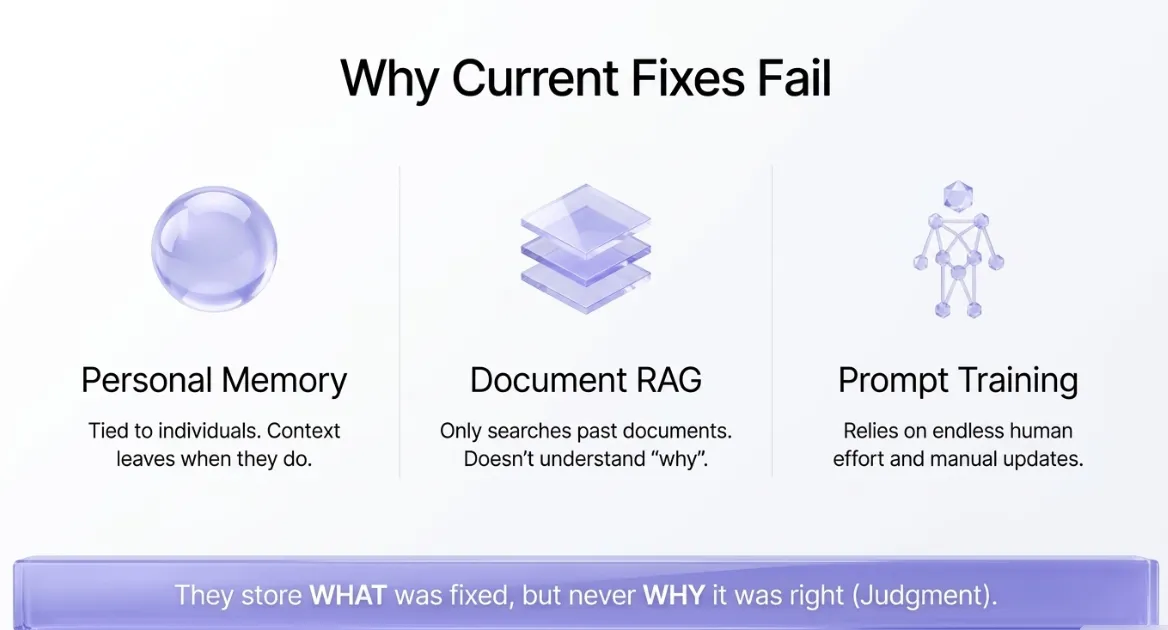
The phrase "turn tacit knowledge into organizational knowledge" spread rapidly in Japan during 2026. Most efforts fall into three types:
- Training / consulting: increase the number of people who can use generative AI and change how information is organized. It leans on human awareness and skill.
- Document RAG: centralize internal documents, manuals, and case histories so AI can search across them. Knowledge-graph hybrids are increasingly common.
- Conversation archive: AI meeting notes and sales-call records automatically accumulate dialogue. What was said is preserved.
None are wrong. But they share a structural limit: the entry point for knowledge is either "documents a human wrote" or "records a machine captured," and the unit being accumulated is not judgment.
| Dimension | Training | Document RAG | Conversation archive |
|---|---|---|---|
| Entry point | Human learning + writing | Documents people author | Recorded dialogue |
| Unit stored | Skills, rules | Document fragments | Utterances |
| Update | Humans keep at it | Manual | Append-only |
| Change control | None | Document versioning | None |
| Output | Relies on human recall | Search answers | Case lookup |
Training depends on people writing and memorizing. Document RAG and conversation archives treat "retrieve and return" as the end goal. But eliminating rework requires not retrieval — it requires not getting it wrong on the next execution. If decision criteria are not connected to the execution layer, AI output will not match the standard, and manual correction never ends.
5. Structure the memory, and the numbers reverse
Databricks' experiments provide the decisive evidence:
- As memory accumulated (past interactions and human feedback), average reasoning steps per task fell from ~20 to ~5.
- Accuracy climbed steadily to 70% — surpassing expert-written domain rules and schemas by about 5 points.
- Most striking: ingesting just 62 unlabeled raw conversation logs — no ground-truth answers — was enough to beat the expert-curated baseline of 33.0%.
Databricks calls this memory scaling: a third scaling axis, distinct from model scaling and inference-time scaling. And the effect is strongest in enterprises rich in tribal knowledge. When a prior success pattern is reused in the next inference, rework is reduced structurally — not by human effort.
The point is whether you build this inside an individual's assistant, or as an organizational foundation.
6. How ARIA is designed to build organizational knowledge
ARIA, developed by Aezisai, is a next-generation AIOS (AI Operating System) platform. It is designed not as a productivity tool but as a cognitive foundation for accumulating, inheriting, and reusing an organization's experience assets. It implements a self-learning loop that structures experience into memory and P2P semantic exchange for distributed learning — continuously converting the tacit crux of judgment that normally stays with individuals into reusable organizational assets.
The four limits of memory features and their rising costs (section 3), and the structural limits of domestic approaches (section 4) — ARIA is designed and built to solve both at the architectural level.
Conclusion: From convenient tool to organizational infrastructure
We are not building "an AI agent that returns chat in place of a human," nor "automation that still needs manual cleanup." We are building sustainable infrastructure that acts as the organization's brain — one that safely retains an organization's know-how, success patterns, rules, and evolving state, so that a new member can deliver top-quality work from day one.
Do you spend the time AI saves you on correcting what AI produced? Or do you convert organizational experience into judgment and structurally reduce rework a little each day? Compounded over a year, that choice becomes overwhelming competitive advantage.
If you suspect your team is spending serious time correcting AI output — or if correction cost is a problem you already feel — let's talk.
7. Frequently asked questions
Q. Can ChatGPT or Claude's memory features build organizational knowledge? A. They work well for remembering an individual's instructions and preferences, but the scope is personal. Context is lost when a member leaves, and organizational decision criteria are never encoded. Third-party evaluations in 2026 characterize it as "memory for one person."
Q. How is this different from searching internal documents with RAG? A. RAG is a mechanism for retrieving document fragments; it does not hold the reasoning behind a decision. ARIA structures decision criteria and processes into memory and reuses them in the next inference.
Sources
- Workday, Beyond Productivity: Measuring the Real Value of AI (Hanover Research, November 2025 field work; 3,200 respondents; published January 14, 2026) — 85% save 1–7 hours/week; ~40% lost to rework; 14% net positive; 77% review burden. https://www.prnewswire.com/news-releases/new-workday-research-companies-are-leaving-ai-gains-on-the-table-302660517.html
- Databricks, Memory Scaling for AI Agents (2026) — reasoning steps ~20 → ~5; 70% accuracy, ~5 points above expert baseline; 62 logs beat 33.0%; warning on low-quality memory. https://www.databricks.com/blog/memory-scaling-ai-agents
- Mem0, State of AI Agent Memory 2026 — BEAM (1M → 10M) score drops 64.1 → 48.6 (~25%). https://mem0.ai/blog/state-of-ai-agent-memory-2026
- MindStudio, What Is the Agent Memory Problem? (2026) — up to 85% of compute in production agents spent rediscovering known context. https://www.mindstudio.ai/blog/agent-memory-problem-vector-search-not-enough
- METR, Measuring the Impact of Early-2025 AI on Experienced Open-Source Developer Productivity (July 2025) — developers 19% slower in RCT (forecast 24% speedup; post-hoc belief 20% speedup). https://metr.org/blog/2025-07-10-early-2025-ai-experienced-os-dev-study/
- Gartner press release (August 26, 2025) — up to 40% of enterprise apps to embed task-specific agents by end of 2026. https://www.gartner.com/en/newsroom/press-releases/2025-08-26-gartner-predicts-40-percent-of-enterprise-apps-will-feature-task-specific-ai-agents-by-2026-up-from-less-than-5-percent-in-2025
- Harvard Business Review, AI-Generated "Workslop" Is Destroying Productivity (September 2025) — MIT Media Lab: 95% of organizations see no measurable return. https://hbr.org/2025/09/ai-generated-workslop-is-destroying-productivity
- Tana, Best organizational memory tools in 2026 (verified July 2026) — ChatGPT/Claude memory is personal-scope, not organizational. https://tana.inc/blog/best-organizational-memory-tools-2026
- JAPAN AI, agent memory release announcement (March 2026). https://aismiley.co.jp/ai_news/japan-ai-agent-memory/