Why AI ROI Still Fails — And How ARIA Solves It Structurally
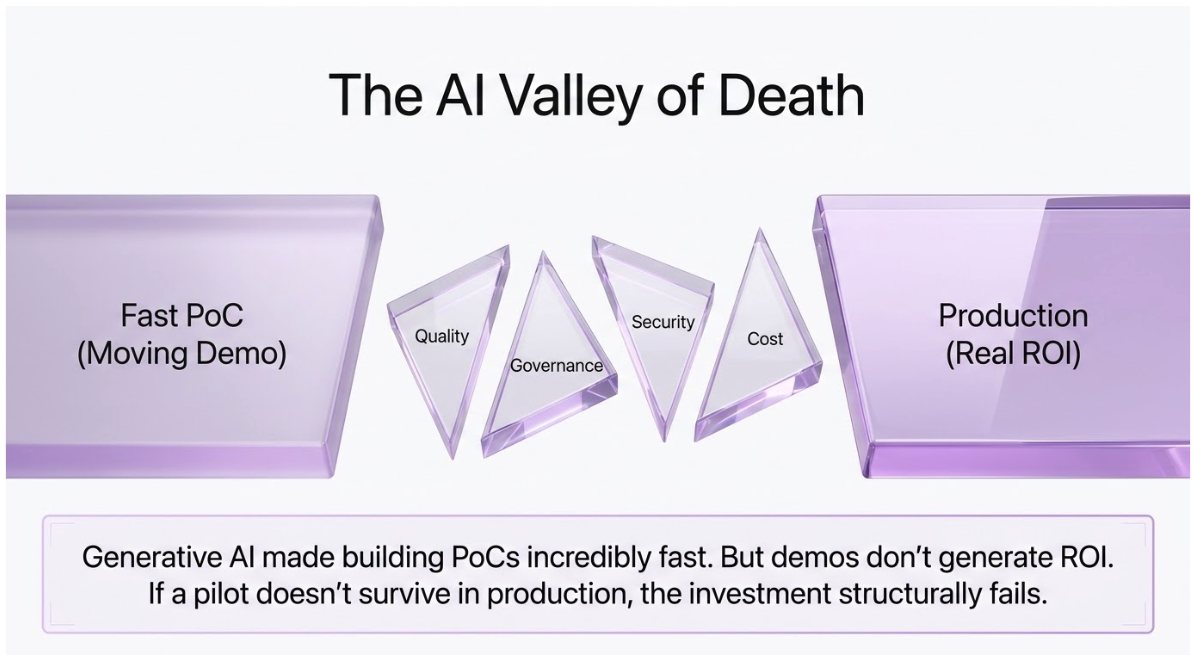
AI investment is growing fast. More companies are getting AI into production, and building a working demo is no longer the hard part. That milestone has already been passed.
The harder question comes after deployment.
Many enterprises can now move from PoC to production. But even then, a large number still struggle to prove real business impact. AI may be live, but ROI often remains vague, delayed, or unconvincing.
That is the real issue.
The question is no longer whether AI made it into production. The question is whether that production AI becomes a durable business asset.
The Real Valley Starts After Production
AI-driven development has made it far easier to build and ship quickly. But speed does not automatically create value.
A growing number of companies are now stuck in a different valley: the gap between having AI in production and being able to show measurable ROI.
That usually happens for four reasons:
- Impact is not measured clearly.
- The link to business outcomes is hard to prove.
- What works in one team does not scale across the company.
- Operations depend too heavily on a few individuals.
This is why so many AI projects succeed technically, but stall economically.
The era of endless pilots is over. The next challenge is not launch. It is sustained value.
What Enterprises Actually Need
Enterprises do not just need better models or faster AI coding tools.
They need an AI-powered operating system that can sit inside real operations, stay under governance, and turn daily execution into long-term organizational value.
That is the role ARIA is designed to play.
ARIA is built to solve the structural reasons AI ROI still breaks down after production.
1. Sandbox Isolation and Human Approval Create Production-Grade Reliability
One of the biggest reasons AI projects fail to generate lasting ROI is simple: quality does not hold up in production.
ARIA addresses this through a 10-phase workflow called the Ecocycle, covering requirements, implementation, validation, and operations. Its orchestration layer manages complex changes across multiple files, while AutoLoop keeps iterating until the work is ready for review.
But ARIA does not write directly into production.
Every change is first tested inside an isolated sandbox. Real files are updated only after a human reviews the diff and explicitly approves it through Apply. ARIA also maintains its own backup structure, including git-based safeguards, so work can be preserved safely throughout the process.
This matters because ROI does not come from speed alone. It comes from reducing rework, preventing careless deployment, and making quality repeatable.
2. Data Sovereignty and Local Fallback Reduce Structural Cost Pressure
Another major barrier to enterprise-scale AI is the combination of security risk and rising operating cost.
Sensitive data cannot be treated casually, and cloud LLM pricing can escalate quickly. In some environments, costs can rise into the hundreds of dollars per person per day. And that cost is not just software. Behind every token sits real infrastructure pressure: data centers, electricity, cooling, and water.
ARIA is built differently.
Its built-in NLG engine runs locally by default, and the broader execution cycle can also be completed within ARIA itself. External LLM usage is optional, not assumed. That means organizations can keep control over where their data goes while still choosing cloud models when needed.
ARIA also supports privacy modes designed for enterprise use:
- Public
- Private
- Team
- Enterprise
If an external model becomes unavailable, ARIA can keep operating through Local Fallback. Combined with secure peer-to-peer connectivity between devices and agents, this reduces both security exposure and cost dependency at the architectural level.
3. Experience Synchronization Turns AI Spend into a Compounding Asset
This is where AI investment stops behaving like a tool expense and starts acting like an asset.
ARIA stores what the organization learns through everyday work. Successful processes are retained and shared. Failed patterns are not simply forgotten. They become lessons the system can avoid repeating.
Over time, those patterns accumulate as structured organizational memory.
The result is not just better output in the moment. It is a system that improves through use. Knowledge compounds. Teams do not have to rediscover the same answers. Proven practices can spread across products and across the organization.
That is what makes ROI durable.
AI investment should not disappear when a project ends. It should remain inside the company as a growing operational asset.
Governance Is Part of the Architecture
No enterprise AI system succeeds in production without governance.
That is why ARIA is paired with ELYSION, Aezisai’s control plane for enterprise oversight. It provides strict tenant boundaries, SSO through ElyAuth, and a trust layer built on decentralized identity.
At a practical level, it answers a core governance question:
Who is running which AI, in which tenant, under which policy?
Without that layer, even strong AI capabilities remain difficult to scale safely across the business.
Structural Cost Reduction Changes the ROI Equation
One of the clearest signs of ROI is structural cost reduction.
ARIA is already being used in enterprise projects for AWS-based core and business systems, supporting clients from PoC and MVP through service launch with just one person working alongside them.
That is not a theory. It is proof that work once assumed to require large teams and heavy coordination can now move forward with far fewer people when supported by the right AI OS foundation.
And when development costs fall structurally, ROI shows up faster.
The idea that one person can effectively perform the role of an SIer is no longer just a vision. It is already being proven in practice.
The Real Divide Is Architectural
The companies that win with AI will not be the ones that build the fastest demos.
They will be the ones that design systems capable of creating ROI long after deployment. Systems that protect quality, control cost, preserve safety, and turn execution into organizational memory.
That is the real divide.
AI investment can remain just another system, or it can become a business asset that grows with the organization.
That outcome is not decided by the model alone.
It is decided by the architecture.
Sources
-
Plug and Play, 2026 Enterprise AI Strategy Pulse Survey (published in Forbes, August 2026) https://www.forbes.com/sites/sandycarter/2026/08/06/enterprise-ai-roi-production-survey/
-
McKinsey, The State of AI: Global Survey 2025 (November 2025 https://www.mckinsey.com/capabilities/quantumblack/our-insights/the-state-of-ai