Why AI ROI Dies in the PoC Valley of Death — And How ARIA Changes That
Investment in AI is surging. Yet the ROI is not there.
The real question is: Did that PoC survive into production?
Over the past year, many companies have mass-produced generative AI PoCs (proofs of concept). AI-driven development has undeniably increased the speed at which PoCs can be built. But the major surveys point to a harsher reality.
According to Plug and Play’s 2026 Enterprise AI Strategy Pulse Survey (August 2026), 74% of large enterprises worldwide already have AI running in production. Yet roughly half of them still cannot prove whether it has actually delivered meaningful results.
McKinsey’s latest survey (published in November 2025) tells a similar story: while 88% of organizations are using AI, only 39% say it has had a measurable impact on enterprise-level EBIT.
And AWS put it bluntly:
“The era of perpetual AI pilots is over.”
In other words, the age of endless AI experiments that never become real business systems is over.
The problem is not a lack of money.
It is not a lack of speed, either.
The money was invested.
But too little remains in production.
That is where we are now.
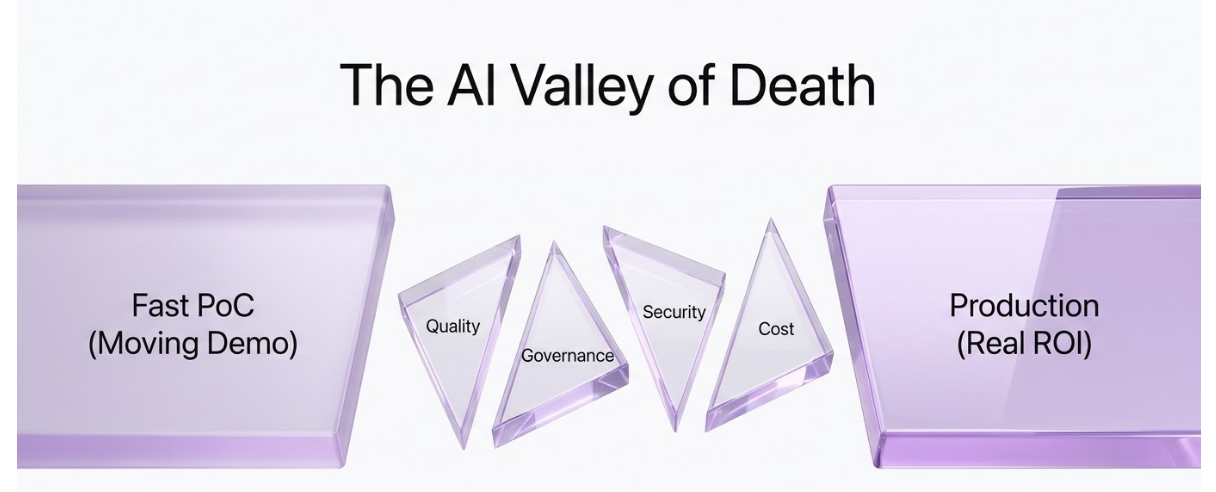
Why ROI Doesn’t Materialize — The “Valley of Death” of PoC
The “Valley of Death” originally refers to the gap between research and commercialization—the empty stretch between invention and actual business use.
In AI, that same gap appears in a very familiar form:
the demo works, but it never makes it into production.
AI-driven development has made it remarkably fast to get to the entrance of that valley. Building PoCs is easier than ever.
The real problem lies on the other side.
Integration into existing operations.
Quality assurance.
Accountability boundaries.
ROI design.
Security and governance.
And the architecture for enterprise-wide rollout.
These are the things that fail to keep up, leaving many PoCs frozen as nothing more than working demos.
And this is the crucial point:
ROI only begins when something reaches production.
At the demo stage, cost keeps accumulating, but revenue gains or structural cost reductions do not.
That means if a PoC cannot survive into production, AI investment is structurally incapable of generating ROI.
The Three Design Principles That Allow ARIA to Realize ROI
What enterprises truly need is not another convenient tool that requires people to start from zero every time.
What they need is an AI operating system—one that understands the company’s own workflows, operates autonomously, and keeps organizational experience as memory even when people move on.
That is what ARIA, the AI OS foundation developed by Aezisai, is built for.
ARIA is not just an AI chat interface or a coding assistant.
It is an AI operating system designed to handle the full flow—from requirements definition to implementation, validation, and operation—and to turn PoCs into real production-grade systems.
Below are the three design principles that make ROI possible.
1. Autonomous Workflows and Sandbox Isolation That Enforce Production Quality
The foundation on which ROI can exist
The biggest reason PoCs fail to move into production is simple: quality cannot be trusted.
ARIA addresses this through a 10-phase autonomous workflow called Ecocycle, which covers the full process from requirements definition to implementation, validation, and operations.
More specifically, ARIA runs a Composer that orchestrates complex changes across multiple files, together with AutoLoop, which interprets work intent and autonomously handles editing and validation.
But ARIA never allows AI to rewrite production environments arbitrarily.
All changes are first tested inside an isolated sandbox and presented as safe side-by-side diff previews.
Without explicit human Apply approval, the workspace is not altered.
This design structurally prevents human shortcuts such as deploying without testing or applying changes without proper verification.
That is the groundwork on which ROI can actually be built.
2. Data Sovereignty and Local Fallback That Minimize Operating Cost
ROI on the cost side
One of the biggest barriers to enterprise-wide rollout is the combination of external data exposure risk and runaway operating cost from pay-per-use cloud LLMs.
ARIA solves this by making its built-in NLG engine—local inference—the default, while external cloud LLM usage remains strictly opt-in. This enables full data sovereignty through a local-first architecture.
ARIA also includes privacy modes that can be adjusted to match the organization’s confidentiality requirements:
- Private
- Team
- Enterprise
In addition, ARIA provides Local Fallback, so operations do not stop even if an external cloud LLM becomes unavailable.
Combined with a secure peer-to-peer network design, where devices and agents connect directly only when needed, this structurally minimizes both security risk and operating cost.
3. Experience Synchronization That Turns Investment into a Compounding Asset
ROI that compounds over time
The third pillar is where ARIA becomes fundamentally different.
The know-how created through AI usage should not remain isolated inside one team or one project. It should evolve into reusable organizational intelligence.
ARIA accumulates the processes learned from daily successes and failures as organizational memory. It can automatically avoid repeating past mistakes by treating them as lessons, while proven success patterns are shared across the organization.
The more it is used, the more experience synchronization advances.
As a result, the value created by AI investment does not end with a single project.
It remains inside the organization as an accumulating asset.
The Foundation for Enterprise Governance: ELYSION
No matter how capable an AI system may be, it cannot be deployed in production unless it can be governed under enterprise control.
ELYSION, Aezisai’s control plane, provides that governance foundation through strict tenant boundaries, SSO via ElyAuth, and a strong trust layer built on DID/VC (decentralized identity and verifiable credentials).
It is designed to guarantee a basic but essential question of enterprise governance:
Who is running which AI, in which tenant, and under what policy?
Structural Reduction of Development Cost — Proof of the “1-Person SIer”
In our own company, we are already using ARIA to drive enterprise projects from PoC to service launch with just one person.
That is a concrete demonstration that enterprise development—once assumed to require large, highly segmented teams—can now move forward with far fewer people when built on top of an AI OS foundation.
If development cost can be reduced structurally, ROI can be realized faster as well.
Our vision of a world where one person can fulfill the role of an SIer is not a theoretical concept.
It is something we have already proven in the field ourselves.
Conclusion: ROI in AI Investment Is Ultimately a Design Problem
The challenge today is not to produce more PoCs that never become real.
The challenge is to ensure AI remains inside the enterprise as a genuine asset.
We are moving out of an era where companies competed on how quickly they could produce a PoC.
We are entering an era where they compete on something else entirely:
the design of an AI operating system that can carry a PoC into production and keep it running.
The old assumption that enterprise development requires hundreds of engineers is beginning to change.
The real question now is whether your company’s AI investment will end as just another demo—or remain as an asset that actually generates ROI.
Sources
- Plug and Play, 2026 Enterprise AI Strategy Pulse Survey (August 2026, featured in Forbes)
- McKinsey, The State of AI: Global Survey 2025 (November 2025)