Why We Are Intentionally Building a True AI-OS While Many Services Are Merely LLM-Based AI Agents
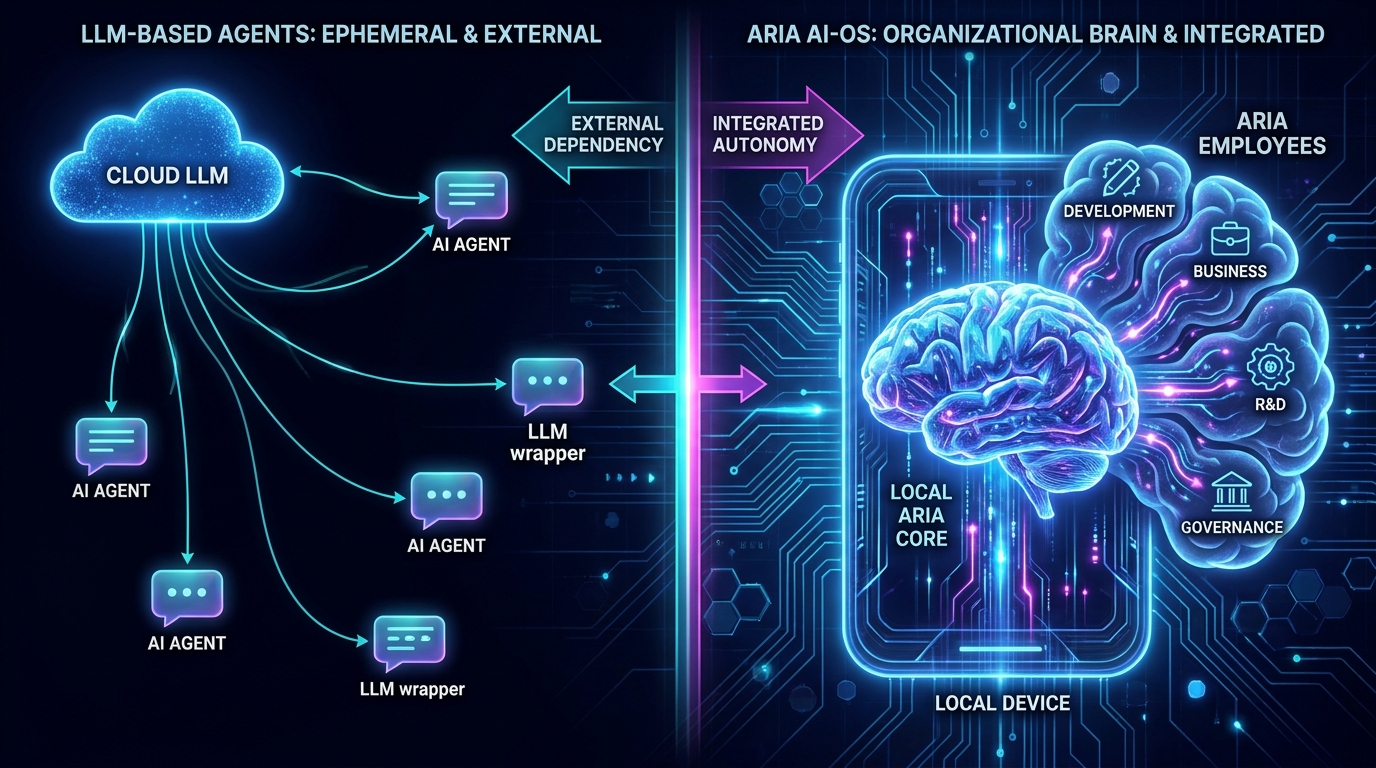
You can see and hear the term "AI-OS" far more frequently on the streets and across online timelines nowadays. However, when you break down most of these offerings, their reality is often nothing more than a "multi-agent tool calling general-purpose LLM APIs" or a "task-automation dashboard built with prompt chains." The current trend is simply attaching the "OS" label to a SaaS product that bundles agent features just to differentiate it from others. Amid this landscape, why are we deliberately spending time and cost to build a "true AI-OS" from scratch using system engineering principles? In this article, I would like to address the discomfort I feel toward the rampant "self-proclaimed AI-OSs" today and discuss the architecture of the "real AI-OS" we are aiming for with our neuromorphic digital twin platform, "Aria."## What Is an "OS" Originally? In computer science, an Operating System (OS) is not just a "collection of convenient apps." The essence of conventional OSs like Windows, macOS, or Linux lies in being a "control foundation (kernel) that manages and abstracts the underlying uncertain and complex hardware (CPU, memory, storage), allowing upper-layer applications to run safely and concurrently." Looking at it from this perspective, calling a "tool that merely invokes LLM APIs sequentially to output text" an "OS" leaves significant room for doubt.
The Decisive Difference Between Conventional OSs and a "True AI-OS"
The AI-OS we envision is not meant to replace Windows. Positioned on top of conventional OSs, it is: > A new layer that manages and controls an organization's "knowledge, intent, and state," rather than "physical computing resources."
| Item | Conventional OS (Windows / Mac) | Mere "Self-Proclaimed AI-OS" | Our Vision for a "True AI-OS" |
|---|---|---|---|
| Managed Target | Hardware (CPU, RAM, DISK) | None (Simply API calls) | Organizational "State" and "Tacit Knowledge" |
| Core Essence | Binary Execution Foundation | Wrapper for General-Purpose LLMs | Neuromorphic Core |
| State Management | File System (Byte Sequences) | Conversation History (Text) | Semantic Version Control (Aria Git) |
| Position of Language Models | None | The Core of the System Itself | An "Output Organ" for Interacting with the Outside |
| Safety & Protection | Memory Protection, Process Isolation | Relies on Prompts | Sandbox, Apoptosis (Autonomous Halt) |
Why Does a "General-Purpose LLM Wrapper" Hit a Wall?
The "LLM-direct" approach adopted by many services faces three critical walls when applied to enterprise operations and actual daily tasks.
- Organizational "Memory" and "State" Are Not Accumulated
General-purpose LLMs are essentially stateless functions. No matter how sophisticated your instructions are, you have to re-explain everything from scratch in a new session. Simply stuffing past logs into prompts (filling up the context window) cannot achieve the "propagation of experience" or the "inheritance of tacit knowledge" within an organization.
- Cloud Dependency and Confidential Data Risks
A structure where confidential company data—such as internal source code, design documents, and customer conversations—is constantly sent to third-party cloud LLMs is difficult to tolerate from a corporate governance perspective.
- Process Uncertainty and Lack of Control
Allowing AI agents to perform business operations without OS-level mutual exclusion or authority management makes it impossible to prevent unexpected destructive changes (such as accidental data deletion or inconsistencies) caused by hallucinations.
Our Approach with the AI-OS ARIA
Our digital twin platform, "Aria," was designed to resolve these structural challenges. Aria's philosophy is clear: "General-purpose LLMs are not the main engine; they are merely sensory and language organs located at the peripheral edges of the brain."
[ ARIA Architecture Structure ]
   [ Application Layer (Addon) ]
   ├── Arthea (Task Execution)
   ├── Prometia (Development Management)
   └── Themis (Training & Code of Conduct)
            ▲
            │ Orchestration
            ▼
   [ AI-OS Core Layer (ARIA) ]
   ├── Neuromorphic Core (Autonomous Evolution & Tacit Knowledge Acquisition)
   ├── Aria Git (Semantic State Management)
   └── Local Sandbox (Execution Control & Safety Assurance)
            ▲
            │ Input/Output Interface
            ▼
   [ Output Organ (Built-in NLG / Cloud LLMs) ]