Beyond FDE: Securing Enterprise AI Core with Aezisai's ARIA AIOS
Summary
- The enterprise AI question has shifted from "should we adopt AI?" to "how do we embed it in core operations and keep control of it?"
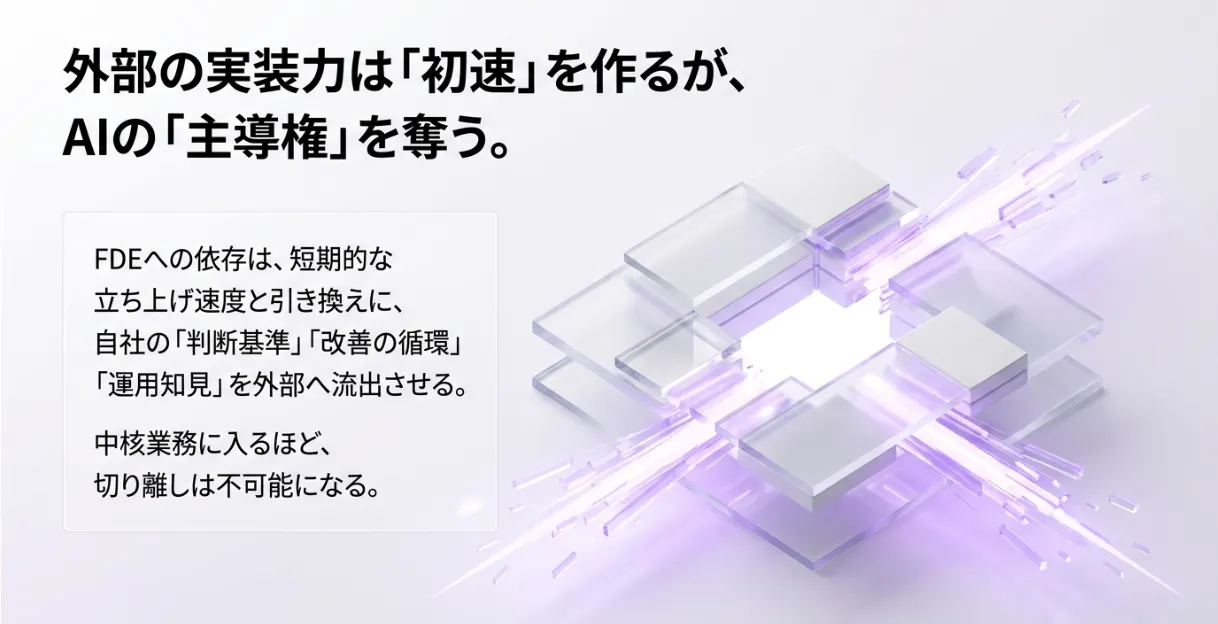
- External implementation capacity (FDE) accelerates the start, but it is not a system that keeps producing value. Supply is finite, knowledge attaches to individuals and contracts, and the deeper AI sits in the core, the higher the cost of separating it later.
- Japan's FDE market is led by job titles, not practitioners. People who can own domain knowledge, business understanding, production implementation, and operations end to end barely exist inside Japanese companies today. For Japanese enterprises, FDE is not a role to hire — it is a role to define and grow.
- Depending on FDE is a short-term speed trade that hands judgment and learning to an outside party. The blocking factor for adoption is organizational, not technical: workflow debt has to be paid down and a continuous improvement loop has to run.
- The answer is an AIOS. ARIA is designed so control stays in-house: local and air-gapped execution, semantic versioning for knowledge inheritance, distributed governance, least privilege, and sandboxed execution. It keeps learning and judgment inside the company rather than renting them.
1. What Happened in 2026 — FDE Becomes an Institution
A Forward Deployed Engineer (FDE) is an engineering role that embeds inside a customer's operations and owns the work end to end: understanding business processes, then designing, building, deploying, and operating the production system. The defining characteristic is that the work does not end at advice or a design handoff — the FDE writes code, makes it run, and fixes it when it breaks. The role was hardened in the public-sector and large-enterprise engagements of an earlier era of data platforms, and it is now widely known.
In 2026, that role became an institution. On May 11, OpenAI established the OpenAI Deployment Company (DeployCo), securing roughly 150 forward deployed engineers and deployment specialists from day one through its agreement to acquire the UK applied-AI firm Tomoro. On May 4, Anthropic announced a new AI services company alongside investors including Blackstone and Hellman & Friedman, staffing it with a similar role it calls an Applied AI Engineer. DeployCo launched with more than $4 billion of initial investment from 19 partners led by TPG, and is majority-owned and controlled by OpenAI.
The engagement model OpenAI describes is explicit: ① a focused diagnostic of where AI can create the most value → ② a small number of priority workflows selected with leadership and operating teams → ③ connecting models to the customer's data, tools, controls, and business processes, then designing, building, testing, and deploying production systems. Published examples include BBVA, which scaled to 120,000 employees across 25 countries, and John Deere, which reported 6x customer engagement and a 70% reduction in chemical usage.
The movement has reached Japan as well. On May 13, 2026, Nork Research published an analysis of how DeployCo and Anthropic's new company will affect Japanese system integrators. Its finding: mid-market and small-enterprise buyers are asking not only for indirect support such as business-process interviews and skills training, but also for help standing up internal promotion teams and unifying data formats — intervention into staffing and data itself. In other words, demand is already shaped like the FDE model.
But Japan's FDE market is led by job titles. People who can own domain knowledge, business understanding, production implementation, and operations end to end are barely present inside Japanese companies today.
For a Japanese enterprise, then, FDE is not a role to hire — it is a role to define and grow in-house. Designing on the assumption that you can bring these people in from outside turns the entire talent gap into a stalled period. How you stand up FDE capability is not a recruiting plan; it is a question of how work gets handed over.
2. Why FDE Dependency Stops Enterprise AI From Growing
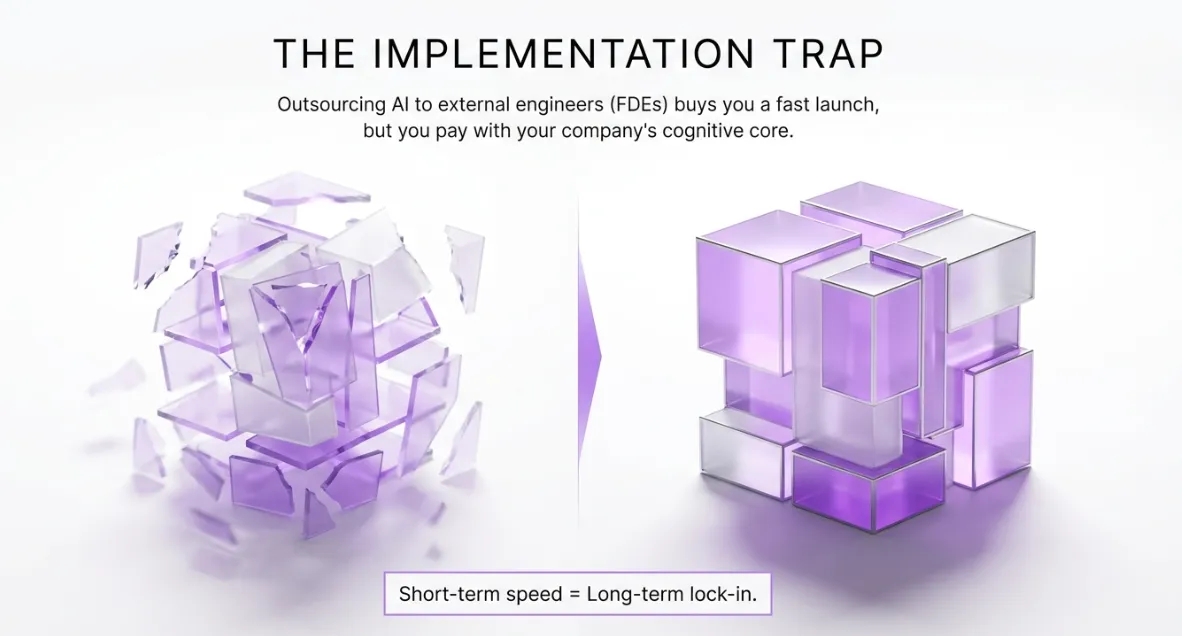
- Supply Constraints & Talent Shortage: Production-ready FDEs (talent capable of executing end-to-end from development to operations) are practically non-existent domestically, making the battle for limited talent a major bottleneck for enterprise-wide rollout.
- Loss of Knowledge: Decision criteria and operational insights remain tied to external contractors, leaving nothing behind when personnel rotate.
- Commoditization: The knowledge advantage in "model selection" and "implementation" is being rapidly eroded by model providers themselves.
- High Decoupling Costs: Relying on external vendors down to permission architecture and audit logging makes offboarding virtually impossible later on.
- Adoption & Organizational Hurdles: The fundamental bottleneck is organizational rather than technical, centering on driving user adoption and streamlining business workflows.
External reliance creates initial momentum, but risks trading away strategic control over your core AI capabilities. To move beyond minor productivity gains, organizations must break free from external dependence and take direct ownership of clearing workflow debt and reinventing business processes.
3. What ARIA Solves — Design Requirements for an AIOS That Keeps Control In-House
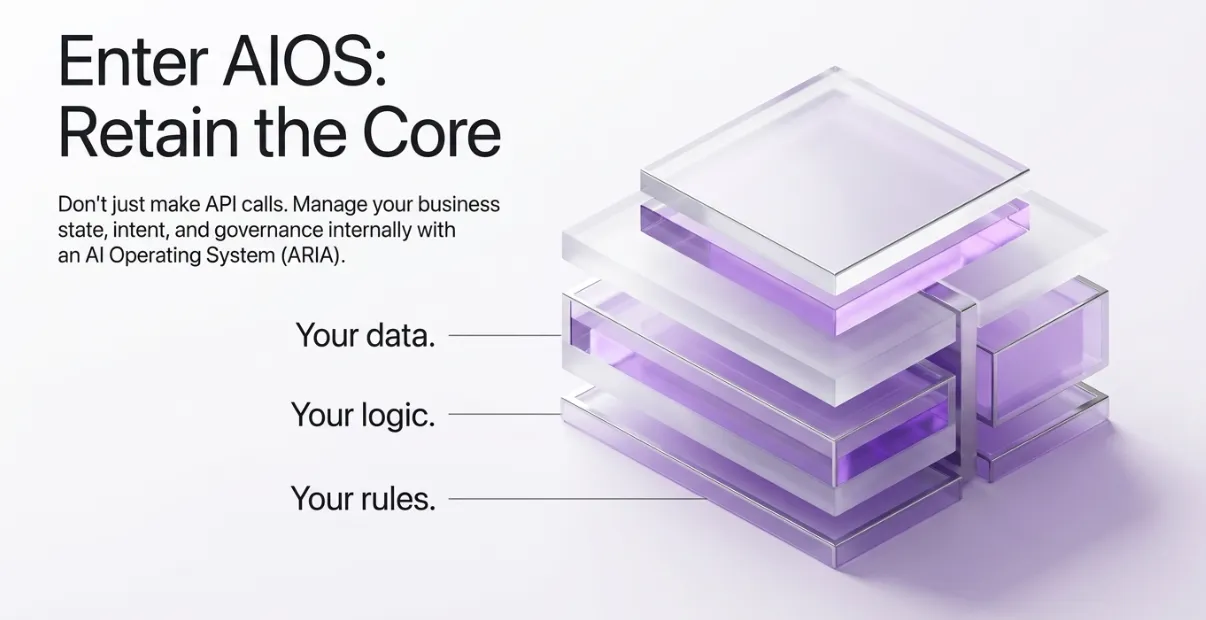
What is actually wrong with designing around FDE dependency? The judgment criteria, the improvement loop, and the operational knowledge of the AI embedded in your operations all accumulate on the outside. What a company putting AI into core operations needs is not more external implementation capacity — it is a foundation where learning and control stay inside. The AIOS "ARIA" starts from that premise.
If AI is going to sit in core operations, the requirements on the operating system side come down to five things.
- Local-first, air-gapped execution — Continuously sending confidential data to third-party cloud models is not viable for governance reasons when AI sits in the core. Execution has to happen in an environment where data and AI sovereignty — the sovereign AI premise — is secured.
- Semantic versioning — Not text diffs, but the diffs of business state and structure. Change intent and history are retained, and conflicts can be resolved with proposed merges (Aria Git).
- Knowledge inheritance — Success and failure patterns accumulate as organizational memory, so a new participant can operate at a consistent quality level from day one.
- Distributed governance — The organization can decide who is allowed to do what with which AI, and that decision is auditable.
- Least privilege and execution control — Agents are not given broad permissions. Sandboxing and autonomous halt are prerequisites, so destructive changes from hallucination are structurally prevented rather than patched afterwards.
ARIA treats general-purpose LLMs not as the main engine but as the output organ that talks to the outside world, and places a core above them that manages organizational state and intent. Capabilities such as business process delegation, development management, and workforce development connect to that core as add-ons, and every execution is controlled inside an isolated environment.
The difference comes down to what is being managed. A configuration that simply calls LLM APIs in sequence can only handle conversation history — organizational state and intent leave no trace. ARIA makes state itself the object of management, records semantic diffs as versions, and controls execution inside an isolated environment.
Choosing a design that depends on FDEs, or holding an AIOS, is a choice between two paths. The longer you depend on external implementation capacity, the further ownership of learning and judgment moves outside. Which one do you think will still hold a competitive advantage and generate revenue a few years from now?
4. Conclusion
The companies that adopted AI and the companies that keep control of the AI now sitting at their core are about to become two different things. The FDE boom is evidence that the argument has moved from technology to business processes and organization. But depending on external implementation capacity is also a choice that removes control of the core from that argument. What is needed is a foundation where judgment criteria, the improvement loop, and operational knowledge accumulate on the inside. Without it, the more successful the results, the harder they become to detach.
The question is not whether to adopt AI. It is whether your company can keep control of the AI that has become its core.
FAQ
Q1. What is a Forward Deployed Engineer (FDE)?
An engineering role that embeds inside a customer's operations and owns the work end to end, from understanding business processes to implementing and operating the production AI system. The discipline was hardened in public-sector and large-enterprise engagements, and in 2026 OpenAI institutionalized it as "FDE" while Anthropic placed the equivalent "Applied AI Engineer" at the center of its new services company.
Q2. Will hiring FDEs make enterprise AI succeed?
It creates initial velocity, but growth does not continue on that alone. Supply is finite, knowledge attaches to individuals and contracts, and implementation advantage commoditizes as models evolve. On top of that, the deeper AI sits in the core, the more it depends on an outside design, raising the cost of separation later. The bottleneck for adoption is organizational, not technical.
Q3. How is the AIOS "ARIA" different from other tools?
It comes down to what is managed. A configuration that only handles conversation history accumulates neither organizational state nor intent. ARIA makes organizational state and tacit knowledge the object of management, and provides semantic versioning, a local-first core, and execution control through least privilege and sandboxing.
Q4. Can FDE and AIOS be used together?
This is not a question of combining them. It is a choice between continuing to rely on external implementation capacity with FDE and keeping learning and decision-making in-house with ARIA. The more you outsource initial velocity, the further the ownership of knowledge and judgment shifts outward.
Sources
Primary sources (official announcements and originals)
- OpenAI, "OpenAI launches the OpenAI Deployment Company" (May 11, 2026) — https://openai.com/index/openai-launches-the-deployment-company/
- OpenAI, "On the frontlines of AI deployment" — https://openai.com/business/the-openai-deployment-company/
- Capgemini press release, "Capgemini strengthens its position in enterprise AI with investment in the OpenAI Deployment Company" (May 12, 2026) — https://www.capgemini.com/us-en/news/press-releases/capgemini-strengthens-its-position-in-enterprise-ai-with-investment-in-the-openai-deployment-company/
- Capgemini, "OpenAI — Technology Partners" — https://www.capgemini.com/about-us/technology-partners/openai/
- Bain & Company, "Want More Out of Your AI Investments? Think People First" — https://www.bain.com/insights/want-more-out-of-your-ai-investments-think-people-first/
- Nork Research press release, "The impact of OpenAI's Deploy Co and Anthropic's new company on system integrators in Japan" (May 13, 2026) — https://japan.zdnet.com/release/31167725/
- OpenAI Careers, "Forward Deployed Engineer (FDE) - Tokyo" — https://openai.com/careers/forward-deployed-engineer-tokyo-tokyo-japan/
- Aezisai blog, "What an OS actually is: the architecture of the AI-OS ARIA" (first-party source) — https://aezisai.co.jp/ja/blog/opinion/building-a-true-ai-os/