AI Governance in Regulated Industries: Designing for Production with Governed Execution

Summary
- “Regulated industry” is a descriptive term, not a globally fixed legal list. Applicable requirements vary by jurisdiction, business activity, AI use case, and potential impact.
- Production AI requires more than model performance. Organizations should assess data access, execution permissions, human approvals, records, change management, and intervention or shutdown procedures in context.
- This article uses Governed Execution as a descriptive label for designing these controls into AI execution workflows. It is not a statutory term, regulator-defined certification, or universal compliance standard.
- ARIA and ELYSION are Aezisai products. ARIA is described as a digital-twin AI that works with an individual’s experience and judgment criteria, centered on the user’s local device. ELYSION is described as an integrated security and control platform for governing access to and coordination among AI products.
- Cronias is Aezisai’s product brand for an enterprise AI ecosystem that includes ARIA and ELYSION.
- NIST’s AI Risk Management Framework (AI RMF) is voluntary. In 2026, NIST has also published work on revising the AI RMF, a concept note for critical infrastructure, and initiatives related to AI-agent identity, authorization, and security.
Note: This article provides general information based on public sources reviewed as of September 25, 2026; it is not legal advice. The applicability of laws in each jurisdiction and the classification of AI systems require case-specific legal and compliance review.
What are regulated industries?
In this article, regulated industries is used descriptively for areas where laws, regulations, licensing or registration requirements, supervisory standards, or sector-specific safety and privacy requirements affect business or professional activities. It is not a universal legal definition or a fixed list shared by every country.
Finance, insurance, healthcare, legal services, and critical infrastructure are examples of areas where such requirements may be relevant. This does not mean that every activity or AI system in these sectors is subject to the same rules.
For example, healthcare document organization, clinical-note summarization, diagnostic or treatment support, and software marketed as a medical device can have different purposes and impacts. In financial services, internal document search is different from AI that supports credit, insurance underwriting, or investment decisions.
The EU AI Act does not assign one uniform set of AI requirements to every business in a named industry. It establishes obligations based on matters including the AI system’s classification and use. Under specified conditions, it can also apply to providers or deployers located outside the EU. Applicability should therefore be assessed against the relevant law, system functionality, intended purpose, and the roles of the parties involved.[1]
| Example area | Examples of AI use (not a determination of regulatory status) |
|---|---|
| Finance and insurance | Credit, underwriting, claims, customer service, and internal risk management |
| Healthcare and life sciences | Clinical documentation, diagnostic or treatment support, medical-device software, and patient-data processing |
| Legal and professional services | Contract review, legal-document drafting assistance, and support for professional judgment |
| Critical infrastructure | Activities involving energy, transport, communications, water, or industrial control systems |
| Public services, employment, and education | Decisions affecting public services, recruitment, evaluation, or access to educational opportunities |
These are illustrative areas, not a legal classification of particular systems. Organizations should assess the relevant jurisdiction, business activity, intended use, and system configuration.
AI governance checks before production deployment
AI may be used to draft review documents, prepare responses to inquiries, assist with contract review, or organize clinical documents. Requirements and appropriate controls vary by use case. As a practical starting point, organizations can assess the following in light of the intended purpose and risk:
- Which data the AI can access and for what purpose
- How the AI, user, and service account are identified and authorized
- Which operations the AI can perform and which require approval
- How AI-generated content is distinguished from human-reviewed or approved work
- Which inputs, outputs, sources, actions, approvals, and changes need to be recorded
- How changes to models, prompts, configuration, rules, and reference data are managed
- How suspected errors, abnormal behavior, or permission violations can be stopped, reversed, or recovered from
- Dependencies on models, infrastructure, external services, suppliers, and continuity arrangements
These are not universal requirements in an identical form for every jurisdiction or use case. The objective is not to complete a checklist mechanically, but to select controls proportionate to the system’s purpose, impact, and place in the workflow.
Three design questions when integrating general-purpose LLMs into business systems
General-purpose large language models (LLMs) can support a wide range of language tasks. An LLM by itself does not automatically provide an organization’s persistent memory, business permissions, approval workflows, or audit records. How those capabilities are provided depends on the surrounding product, systems, configuration, and operating procedures.
1. How will experience and decision context carry forward?
Using AI through sessions and prompts does not necessarily make successful or unsuccessful outcomes, or the reasoning context behind a decision, persistent organizational knowledge.
To reuse organizational knowledge, teams need to determine what to record, how to handle personal and confidential information, who may view or update it, and how outdated knowledge is reviewed. Accumulating knowledge does not automatically guarantee better accuracy; it requires evaluation, governance, and maintenance.
2. How will model, infrastructure, and data dependencies be managed?
AI operations may involve considerations such as model providers, cloud and infrastructure services, data-processing and storage locations, service or model changes, and continuity during outages.
Local processing is one design option for data management and dependency planning. However, running a model locally does not by itself resolve authorization, output quality, knowledge maintenance, auditability, vulnerability management, or external connectivity. Organizations should verify actual data flows, storage, communications, backups, telemetry, and update mechanisms for the deployed product and configuration.
3. How will generation be separated from business approval and execution?
Generating a contract-review draft is different from finalizing contract terms. Producing a proposed customer response is different from sending it.
Based on business impact, organizations can define which tasks AI may perform, which require human review or approval, and which operations are not permitted. The person responsible for review, approval, stopping, and resuming a process should be aligned with the organization’s authority structure.
AI governance developments in primary sources as of September 2026
The following are examples of public primary sources available as of September 25, 2026. Laws, supervisory guidance, voluntary frameworks, draft guidance, and policy recommendations have different legal status. This table is not exhaustive and does not determine whether a rule applies to a particular organization or system.
| Jurisdiction or body | What the primary source says | How to interpret it |
|---|---|---|
| EU: AI Act | A risk-based legal framework for AI systems. The consolidated text incorporating the 2026 amendment provides for general application from August 2, 2026, with specified high-risk AI obligations applying from December 2, 2027, or August 2, 2028, depending on the category.[1][2] | Assess the system classification, the parties’ roles, applicable provisions, and dates. Industry name alone does not determine classification. |
| EU: DORA | Sets requirements for covered financial entities concerning ICT risk management, reporting of major ICT-related incidents, digital operational resilience testing, and ICT third-party risk, among other matters.[3] | DORA is not an AI-specific law. Assess whether AI systems or related services form part of covered entities’ ICT environment or third-party dependencies. |
| United States: Federal Reserve, FDIC, and OCC | The April 2026 revised model-risk guidance excludes generative and agentic AI models from its definition of “model,” while stating that an organization’s risk management and governance practices should guide appropriate controls for tools and systems outside the guidance.[4] | Exclusion from this guidance should not be read as “no controls are needed.” The guidance itself is not a comprehensive AI-specific regulation. |
| United States: NIST | NIST describes the AI RMF as intended for voluntary use. Its official page says AI RMF 1.0 is being revised; in April 2026, NIST published a concept note for a Trustworthy AI in Critical Infrastructure Profile.[5][6] | Distinguish voluntary frameworks and concept notes from binding laws or regulations. |
| United States: NIST agent initiatives | NIST’s AI Agent Standards Initiative addresses security, interoperability, authentication, and identity. NCCoE is exploring identification, access management, and authorization approaches for software and AI agents.[7][8] | These are standards, research, and practical exploration activities; they should not be described as a universal legal obligation or a completed certification scheme. |
| United States: FDA | FDA published 2025 draft guidance on lifecycle management and marketing submissions for AI-enabled device software functions. FDA labels it draft and states it contains non-binding recommendations.[9] | Distinguish draft guidance from final guidance, and medical-device software from other AI uses. |
| United Kingdom: healthcare AI | On September 10, 2026, an independent commission published recommendations for a future healthcare AI regulatory framework, including lifecycle monitoring and system-wide responsibility and governance.[10] | The report contains recommendations for consideration; it is not itself current legislation. |
| United Kingdom: financial services | The government’s 2026 Financial Services AI Adoption Plan discusses scaling adoption, regulatory clarity, and resilience in the context of the existing framework.[11] | This is a policy plan, not by itself a new binding AI regulation. |
These sources do not establish that every regulator requires the same control model. They do show why organizations need to consider risk, purpose, organizational roles, and execution capability in the context of applicable legal and supervisory frameworks.
What is Governed Execution?
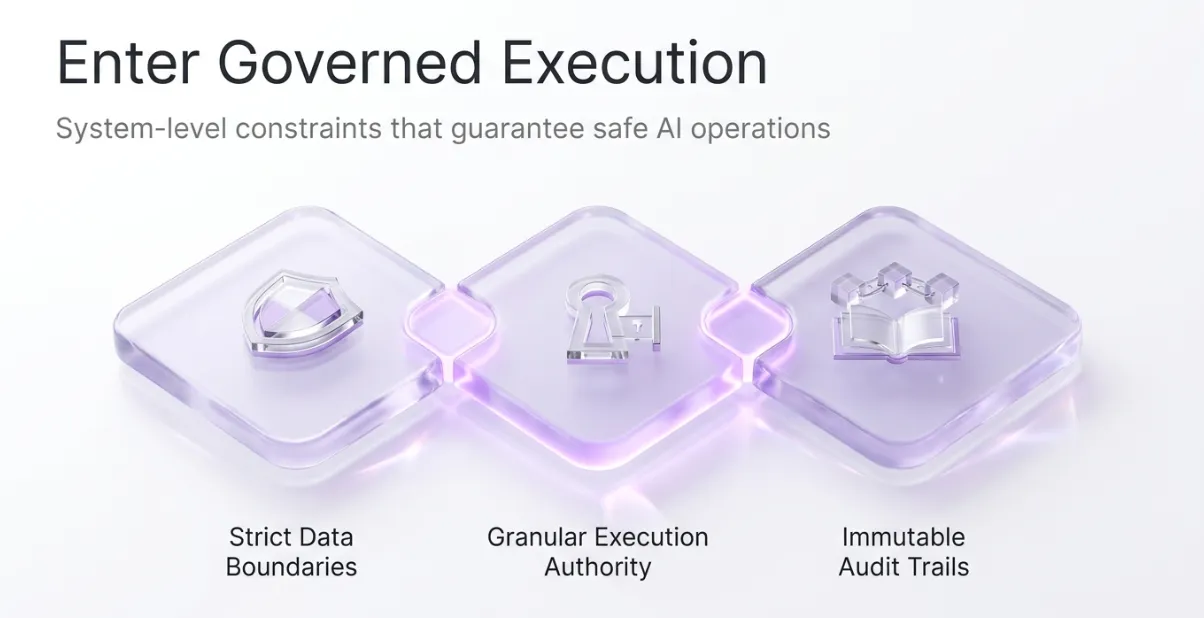
When deploying AI in activities affected by regulatory or supervisory requirements, it is important to decide in advance what the AI may do, which data it may access, which operations it may perform, and where human approval is needed.
In this article, Governed Execution is a descriptive label for designing AI permissions, approvals, and records into execution workflows. It is not a statutory definition, an official NIST term, a certification, or a unified standard established by regulators.
Practical design questions include:
- Data boundaries: What information may the AI access or process? Where is it stored, and under what conditions can it be sent externally?
- Identity and authorization: How are the AI, users, and service accounts identified, and how is access limited to what is necessary?
- Approval: Which actions require human review or approval based on their impact?
- Evidence and records: Which inputs, sources, outputs, actions, approvals, and changes need to be recorded?
- Change management: How are changes to models, settings, prompts, knowledge sources, and tool connections assessed?
- Stopping and recovery: How can execution be stopped, permissions revoked, and the workflow returned to a safe state?
- Human oversight: How can staff understand the AI’s role and limitations and intervene when needed?
This does not mean every AI use requires every control in the same form. The appropriate scope and rigor depend on risk, business impact, and applicable laws and policies.
For example, an organization may treat AI-assisted contract review as a separate step from final approval of contract terms. The AI may support review, while a designated employee confirms or approves the final decision. Which actions can be automated should be determined from the actual workflow, authority rules, and risk assessment.
ARIA: Aezisai’s digital-twin AI product
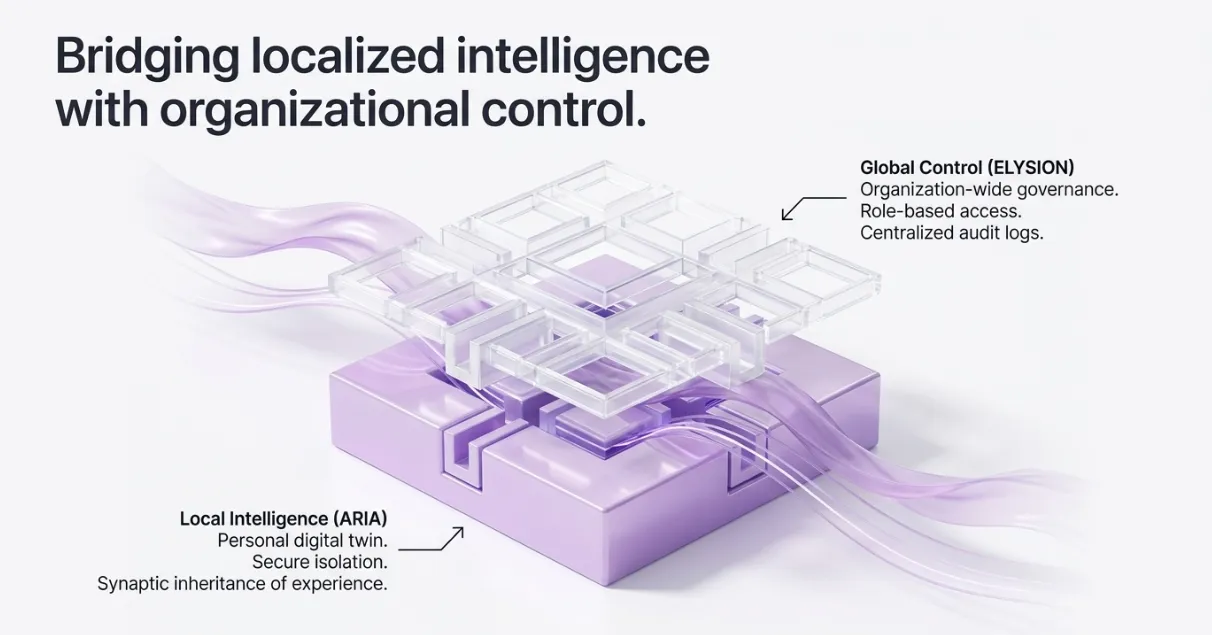
ARIA is an AI product developed by Aezisai. It is designed as a digital-twin AI that works with an individual’s experience and judgment criteria, centered on the user’s local device.
Here, “local” refers to a design centered on the user’s own device for handling experience and judgment criteria. It should not, by itself, be taken to mean that every process, storage operation, or communication occurs entirely on that device. Actual data flows, external communications, retention and deletion, backups, and updates should be verified against the product specifications and deployed configuration.
ARIA is intended to connect experience from day-to-day development and decision-making to future work. According to the product information provided by Aezisai, its design includes a “Synaptic Inheritance Chain” for carrying forward experience, permissions, and context, and “neuromorphic inference” for reflecting experience in subsequent reasoning.
| ARIA design element | Product description |
|---|---|
| Local-device-centered design | Aims to handle an individual’s experience and judgment criteria primarily in the user’s local environment |
| Synaptic Inheritance Chain | Described as a mechanism for connecting experience, permissions, and context to continuing decisions and execution |
| Neuromorphic inference | Described as a design intended to reflect successful and unsuccessful experience in later processing |
| Isolated execution environment | Described as a controlled environment for business or development tasks |
| Approval gates and stop controls | Described as controls for unapproved outputs or potentially risky operations |
These descriptions are based on product information supplied by Aezisai. For procurement or deployment decisions, organizations should verify currently available functions, technical specifications, evaluation results, retention and deletion conditions, threat models, and evidence that can be independently reviewed.
ELYSION: Aezisai’s integrated security and control platform
ELYSION is also an Aezisai product. It is positioned as the integrated security and control platform for AI products within Aezisai’s Cronias product brand.
According to the product information supplied, ELYSION is designed around centralized management of secure sign-in, access permissions, audit logs, and contracts, supporting the use and coordination of AI products.
The product description also presents a path for extending knowledge developed through ARIA to organizations or public contexts, with tamper-resistance and reflection into an organization-side source of truth. Sharing individual knowledge responsibly requires decisions about what is shared, who can access it, where it is reflected, who approves it, what history is retained, and how corrections or withdrawals are handled.
Cronias: Aezisai’s AI product brand
| Product or capability | Position within the Aezisai ecosystem |
|---|---|
| ARIA | Digital-twin AI designed to work with individual experience and judgment criteria, centered on the user’s device |
| ELYSION | Security and control platform for identity, permissions, audit logs, contracts, and related governance |
| Organization-side source-of-truth reflection | A described approach for bringing individual knowledge into organizational assets through a managed process |
| Cronias | Aezisai’s enterprise AI product brand, including ARIA and ELYSION |
ELYSION is intended to connect individual development with organizational growth. On this trust foundation, Aezisai’s stated direction includes enabling AI product composition, partner connections, and access to execution capabilities.
Conclusion: Evaluate production conditions as well as model performance
“Regulated industry” is not a globally fixed list. Applicable laws and supervisory requirements vary by jurisdiction, business activity, AI purpose, and potential impact.
When assessing production AI, organizations should evaluate more than model performance. Depending on the use case, they should consider data boundaries, permissions, approvals, records, change management, and stop-and-recovery procedures. Where AI can act in business systems, define who authorizes each action, what evidence is retained, and where human judgment is required.
This article uses Governed Execution as a descriptive term for that design approach. It is not an official regulatory term or certification.
ARIA and ELYSION are Aezisai products. ARIA is described as a digital-twin AI centered on an individual’s device and experience; ELYSION is described as a platform for governing the use of and knowledge-sharing across AI products. Together, they form part of the Cronias ecosystem. For deployment decisions, distinguish product design claims from verified implementation and operating specifications.
Learn from individual experience, connect it to the organization under governance, and use it in future work.
For organizations bringing AI into production, a practical starting point is to design data, permissions, approvals, evidence, and accountability alongside model evaluation.
Talk to Aezisai
Aezisai offers a 30-minute free consultation on AI use in activities affected by regulatory or supervisory requirements, including security and governance design. Use it to clarify your organization’s AI-use challenges and discuss possible design approaches involving ARIA and ELYSION.
👉 [Learn more about Cronias, Aezisai’s AI product brand]
Frequently asked questions
1. What does “regulated industry” mean?
In this article, it is a descriptive term for areas such as finance, insurance, healthcare, legal services, and critical infrastructure where laws, regulations, licensing, supervisory standards, or safety and privacy requirements may affect activities. It is not a universal fixed list. Applicability depends on jurisdiction, activity, and AI use case.
2. Do all AI systems in the same industry face the same requirements?
Not necessarily. Requirements and risks may differ based on the AI’s purpose, functionality, role in decision-making, affected people, and jurisdiction, even within the same sector.
3. Is Governed Execution an official regulatory term?
No. This article uses it as a descriptive label. It is not a statutory definition, official NIST terminology, certification scheme, or unified regulator-established standard. Here, it means designing permissions, approvals, and records into AI execution workflows.
4. Does running AI locally eliminate data or security risks?
No. Local processing is one data-management option. Organizations should still assess permissions, external communications, retention and deletion, backups, updates, auditability, vulnerabilities, and integrations based on the actual data flows and product configuration.
5. Are ARIA and ELYSION Aezisai products?
Yes. ARIA and ELYSION are Aezisai products. ARIA is described as a digital-twin AI that works with individual experience and judgment criteria, centered on the user’s device. ELYSION is described as a security and control platform for governing access to and coordination among AI products.
6. How are Cronias, ARIA, and ELYSION related?
Cronias is Aezisai’s product brand. It is an enterprise AI ecosystem that includes ARIA, ELYSION, and other products, with the stated aim of connecting individual knowledge to organizational execution.
7. Is the NIST AI RMF mandatory for companies?
NIST describes the AI RMF as intended for voluntary use. It is not a law mandating a specific product or implementation method. Organizations should consider it separately from applicable laws and supervisory requirements.[5]
8. Does the EU AI Act apply only to companies located in the EU?
Not necessarily. Article 2 of the EU AI Act specifies circumstances in which providers or deployers located outside the EU may fall within its scope. Applicability should be assessed against the article’s conditions and the organization’s actual activities.[1]
Sources
- European Union, Regulation (EU) 2024/1689 (Artificial Intelligence Act), consolidated text
https://eur-lex.europa.eu/legal-content/EN/TXT/HTML/?uri=CELEX:02024R1689-20260727
- European Union, Regulation (EU) 2026/1744: Digital Omnibus on AI
https://eur-lex.europa.eu/eli/reg/2026/1744/oj/eng
- European Union, Regulation (EU) 2022/2554: Digital Operational Resilience Act (DORA)
https://eur-lex.europa.eu/eli/reg/2022/2554/oj/eng
- Federal Reserve, FDIC, and OCC, Revised Guidance on Model Risk Management, SR 26-2 (April 2026)
https://www.federalreserve.gov/supervisionreg/srletters/SR2602.pdf
- U.S. National Institute of Standards and Technology (NIST), AI Risk Management Framework
https://www.nist.gov/itl/ai-risk-management-framework
- NIST, AI RMF Profile on Trustworthy AI in Critical Infrastructure: Concept Note
- NIST, AI Agent Standards Initiative
https://www.nist.gov/artificial-intelligence/ai-agent-standards-initiative
- NIST National Cybersecurity Center of Excellence (NCCoE), Software and AI Agent Identity and Authorization
https://www.nccoe.nist.gov/projects/software-and-ai-agent-identity-and-authorization
- U.S. Food and Drug Administration (FDA), Artificial Intelligence-Enabled Device Software Functions: Lifecycle Management and Marketing Submission Recommendations (2025 draft guidance)
- UK Government and Medicines and Healthcare products Regulatory Agency (MHRA), National Commission into the Regulation of AI in Healthcare: Recommendations for a future regulatory framework (published September 2026)
- UK Government, AI Adoption Plan: Financial Services (2026)