The Real Multi-Agent Threat: Chained Misjudgments
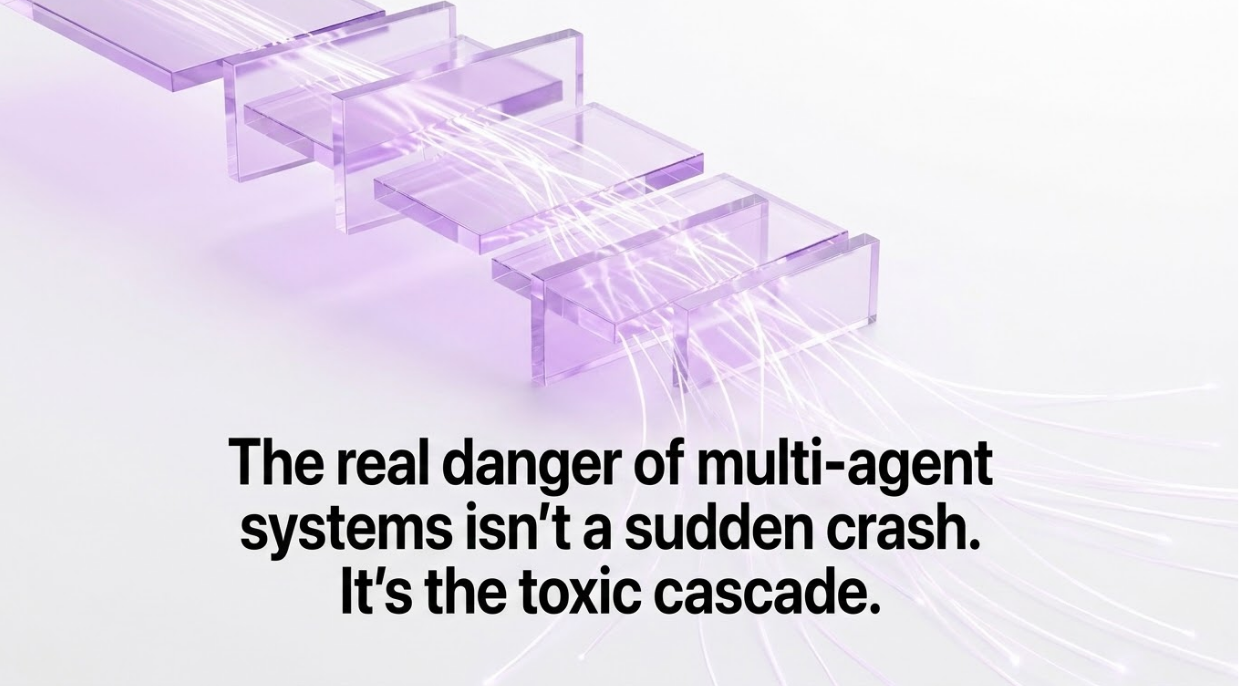
The more agents you deploy, the faster your business moves.
But for an executive, the true nightmare isn't a spectacular system crash. The real danger is "Silent Corruption": a minor misjudgment or a slight overstep of authority by a single agent that is accepted as "valid input" by the next. Left unchecked, this contamination seeps through your company’s data and decision-making processes, poisoning the very foundation of your operations.
McKinsey categorizes these risks as chained vulnerabilities, cross-agent task escalation, and data corruption propagation. The threat isn't just the accuracy of a single unit; it’s that the collaboration itself becomes the highway for failure and contamination.
Aezisai isn't building "smarter agents." We are building an execution architecture that ensures a single misjudgment never becomes the input for your entire organization.
1. Silent Corruption is Deadlier Than a Loud Crash
A failure in a standalone AI is usually a localized incident: one wrong answer, one bad summary, one flawed ticket. The blast radius is small, and the source is easy to pin down.
In a multi-agent environment, the game changes. At first, it looks incredibly efficient—agents delegating tasks, working across departments, and moving faster than any human. But beneath the surface, a single false premise, a broken ID, or a piece of "dirty" master data is passed to the next agent as "trusted input."
This isn't just a dip in accuracy. The bedrock of your decision-making is being contaminated. This pollution accumulates across departments until it finally surfaces as a compliance violation, a customer service disaster, or a critical financial error.
For leadership, the most terrifying part isn't the accident itself—it’s the loss of explainability. If you cannot reconstruct when it happened, under whose authority, which agent triggered the first error, and how it rippled through the system, you have lost control. You cannot pass an audit, and you cannot design a fix.
Without governance, multi-agent systems trade accountability for speed, eventually dragging the entire company into the mud. You don't just need a "kill switch"; you need a design that breaks the chain of failure.
2. The Problem Isn't "Intelligence"—It’s the Hand-Off
Discussions about AI often obsess over model performance: accuracy, speed, prompts, and tool integrations. While important, the real focus in a multi-agent environment must be the hand-off design—what each agent receives and what it passes on.
McKinsey’s identified risks focus specifically on these connection points:
- Chained Vulnerabilities: Error A becomes the premise for Agent B, which becomes the basis for Action C.
- Cross-Agent Task Escalation: A low-risk task escalates into a high-risk operation via another agent.
- Data Corruption Propagation: Corrupted data is utilized cross-functionally as "truth."
More agents mean more convenience, but they also mean more paths for contamination. Risk and reward share the same wiring.
The priority is clear: before you scale connections, you must establish an execution structure that prevents chaining. Adding agents without this foundation isn't automating your business—it’s pre-installing the plumbing for a company-wide data leak.
3. Aezisai’s Answer: An "Interruption-Proof" Execution Structure
At the core of Aezisai is ARIA. It is not just an AI assistant or an automation tool. Its philosophy is embedded in its name: Autonomous Runtime with Inherited Authority.
- Autonomous: It acts independently, but only within inherited boundaries.
- Runtime: We design the execution structure itself, not just the prompts.
- Inherited Authority: It never assumes power; it receives it in a strictly bounded form.
Agents shouldn't act just because they are "smart." They should act only within the scope of the authority and experience they have inherited. If you break this rule, autonomy quickly becomes the gateway to unauthorized actions and data corruption.
Aezisai integrates authentication, execution, governance, and auditing into a single foundation:
- ELYSION [Identity & Authority]: The trust gate that clarifies who is acting and at what risk level.
- ARIA [Execution Core]: The runtime for autonomous action under inherited authority.
- ARTHEA [Execution Portal]: Manages cross-departmental tasks and escalates exceptions to humans.
- THEMIS [Observation & Governance]: The layer responsible for quality, explainability, and auditability.
We aren't just "multiplying agents." We are building a platform where authority, execution, and auditing are separated yet connected in a fully traceable way.
4. Five Pillars of Chain-Failure Prevention
These aren't operational tips; they are the architectural requirements Aezisai is built upon:
- Eliminate Ambiguity of Authority: Don't let the system forget who the agent is representing. Execution must always be tied to Inherited Authority, connecting roles and risk levels directly to the execution path.
- No "Bypassing" Human Approval: In high-risk operations, "probably fine" is a failure. We implement a "fail-closed" approach where approval, confirmation, or intervention is hardcoded into the flow.
- Architectural Task Blocking: Prevent "Task Escalation" by design. A low-risk task (like summarizing) should be structurally unable to escalate into a high-risk one (like moving funds) without a hard reset of authority.
- Isolate Failures: Never allow a single agent's failure to be promoted to "organizational knowledge." We separate "learning from failure" from "inputting failure," isolating the spread of contaminated logic.
- Audit Every Hand-Off: You must be able to reconstruct every event: who, when, which agent, what input, and who approved it. Governance isn't about having a stop button; it’s about the structure that supports accountability.
5. Why Model Improvements Aren't Enough
Reducing hallucinations and improving context understanding is vital. However, the core risk of multi-agent systems remains: even a high-precision agent will propagate a false premise if allowed. Even a brilliant agent will overstep if there are no boundaries.
Aezisai doesn't rely on the "intelligence" of the model for safety. We bake safety into the execution structure itself. By creating a system where misjudgments cannot chain, we allow humans to stop worrying about the "plumbing" and focus on high-level decision-making and creativity.
6. Build the Foundation Before You Scale the Agents
The urge to connect dozens of agents at once is strong, but the sequence matters. Before you count your agents, you must:
- Define the boundaries of authority.
- Place approval gates based on risk.
- Structurally block dangerous task escalations.
- Isolate failures to prevent "pollution promotion."
- Make every hand-off auditable.
- Only then, increase the complexity of connections.
Skipping these steps means you aren't building a smarter company—you're just wiring it for a faster disaster.
Conclusion
The multi-agent era demands more than just an emergency brake. It demands a design that prevents the chain reaction of failure.
The risks identified by McKinsey aren't futuristic warnings; they become real the moment you connect your second agent. Aezisai builds the execution foundation where authority is inherited, approvals are mandatory, and every action is explainable.
Learn from reality. Inherit authority. AI only functions safely within an organization when it respects these boundaries.
Consult with Us
Not sure where to start with "defining authority," "placing approval gates," or "ensuring auditability" for your multi-agent rollout? Let’s map it out together. [Contact us via Chat]