94% of AI Projects Fail to Show ROI. Here is the Blueprint for Success: "Experiential Sync" AI.
The "Experience-Synchronized" Design Philosophy: Turning Regret Spend into a Compounding Asset
In many companies, the monthly invoice for AI arrives like clockwork. Meanwhile, a tangible sense of how the organization's decision-making and competitiveness have changed is rarely felt.We are currently witnessing an anomaly where 94% of companies state they will "continue AI investments even without clear ROI" (Mavvrik, 2026). However, only a handful of enterprises are succeeding in creating meaningful value and scaling AI.Activity is happening. Dashboard utilization rates are trending upward. Yet, organizational knowledge remains confined within individuals' heads, and the same mistakes are repeated across different teams. This is no longer a business investment; it is an endless loan where payments to external LLMs compound structurally—this is Regret Spend.In this article, we unravel why this gap emerges and explain how ARIA, the Experience-Synchronized AI Operating System foundation we are developing, redesigns this very structure.## 1. The Cruel Disconnect Between "Activity" and "Transformation"
The current state of enterprise AI faced by many companies can be summarized by the following facts:
- Dissatisfaction with Impact: Over half of CEOs report that "the revenue and cost-saving impact of AI is zero."
- The Scaling Wall: Despite increasing investment, a mere 6% of companies have successfully deployed AI company-wide.
- The Illusion of Productivity: While employees feel that "work has gotten faster," approximately 40% of the time saved is consumed by "reworking AI outputs."
Only 14% of companies consistently deliver net-positive results. "We got faster, but we didn't get smarter." This is the current reality for most organizations.The difference between the top companies achieving dramatic revenue growth with AI and the rest is not the intelligence of the models. It lies in whether there is a mechanism to retain experience within the organization.## 2. Why Investments Turn into "Depletion"
2.1 You Are Paying a Monthly Fee for a "System Where Business Outcomes Leak Away"
In much of today's AI usage, the good decisions and know-how generated on the frontlines are not accumulated; instead, they are in a state of "leaking out" from daily operations.Generic AI, lacking organizational context, experiences a drop in success rates during multi-turn tasks. Conversely, when organizational memory and context are provided, reasoning steps are shortened, and accuracy skyrockets. This difference might seem small over a single month, but it becomes fatal over a year.Many companies continue to consume AI not as "their own foundation," but as a "convenient external tool." The chat ends, the prompt disappears. Good and bad decisions alike fail to become anyone's asset, and the outcomes of business activities slip through their fingers and vanish. That is exactly why the same hesitations and inconsistencies are repeated in other projects.### 2.2 Deploying Tools is Not Organizational Transformation
Purchasing licenses and preparing an environment to use AI does not solve issues like the following:
- Frameworks for requirement gathering still exist only in individuals' heads.
- What to look for during reviews remains an oral tradition.
- The reasons for "why a process was halted" or "why it was approved" are not left in the logs.
Tools have been deployed, but organizational knowledge has not. This is the true nature of Regret Spend.## 3. ARIA's Philosophy: Designing to Retain Experience in the Organization
Inside companies, there is a "labyrinth of tacit knowledge" tied to individuals, such as veterans' judgment criteria and perspectives learned from failure. While generic AI walks through this labyrinth from scratch every single time, ARIA leaves footprints behind as reusable assets.****Experience-Synchronized AI — Capitalizing on corporate tacit knowledge.****ARIA is not merely a chatbot; it defines the category of an Experience-Synced AI Agent and is designed as an OS that extends the organizational brain.### 3.1 The "Compounding of Knowledge" Brought by Experience Synchronization
The implementation of ARIA directly becomes a process of building organizational assets.
- Start with a single team: Frameworks for requirements and review criteria transition from one-off conversations into reusable assets.
- Expand to the department: Other teams stop repeating the same mistakes, and individual learning curves transform into an organizational learning curve.
- Grow into a company-wide standard: Individual intuition is provided as "explainable judgment," and experience assets remain even when people leave.
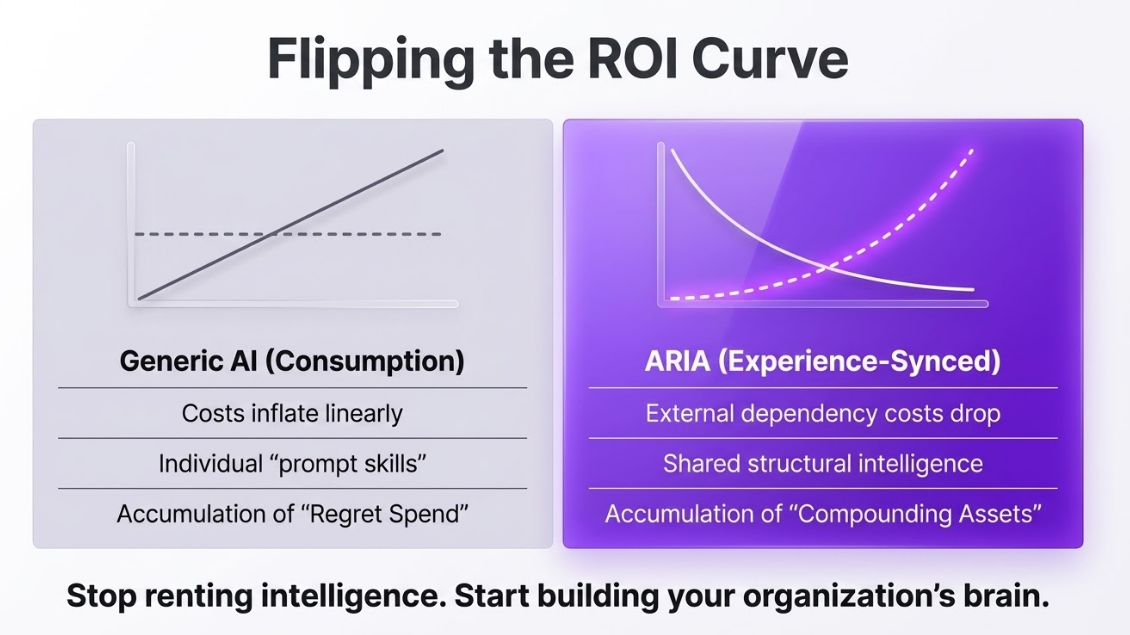
While generic AI usage racks up external API costs the more it is used, ARIA accumulates judgment frameworks the more it is used, driving down the external dependency costs required to achieve the same results.### 3.2 The "6-Layer Synaptic Architecture" for Retaining Experience
ARIA's intellectual foundation is a 6-layer architecture modeled after the human cerebral cortex. It categorizes principles, heuristics, implementation knowledge, operations, and episodic memory into layers, feeding both successes and failures back as feedback.The key is not to "buy a smart model," but to "index experience and retain it in a state usable for the next decision." It absorbs frontline experience, converts it into safely usable decision-making power, and distributes it across the entire organization. This is ARIA's design promise.### 3.3 The "Trinity" Design for Confident Delegation
Merely retaining experience is not enough to delegate practical work. ARIA achieves safe delegation by distributing the following roles across its entire ecosystem:
- ARIA: Handles "Judgment, Execution, and Experience Synchronization," functioning as the organizational brain to capitalize on experience.
- THEMIS: Handles "Training and Codes of Conduct," cultivating a decision-making style specific to the company.
- ARTHEA: Handles "Business Rules and Approvals," preventing deviations and ensuring humans make the final decisions.
- Ethical Safety: Handles "Detection, Halting, and Explanation," turning the anxiety of delegation into explainable reasons for stopping.
4. Flipping the ROI Curve
The massive value creation demonstrated by advanced global enterprises is not magic; it is the "result of compounding interest from continuously encoding organizational intelligence into systems." The difference between generic AI (Consumption-based) and ARIA (Experience-Synchronized) is clearly evident in the following points:
- As usage increases: With generic AI, "only the billing amount inflates," whereas with ARIA, "the external dependency cost per unit of output decreases."
- What remains in the organization: Generic AI leaves only "individual prompt familiarity," but ARIA accumulates "frameworks for requirements, review criteria, and success patterns."
- When an employee leaves: With generic AI, "know-how disappears with them," but with ARIA, "experience assets remain in the organization."
- The landscape after one year: Generic AI results in an "accumulation of Regret Spend," while ARIA results in an "accumulation of Compounding Assets."
- The fundamental difference: Generic AI is a "monthly subscription to a system where outcomes leak away," whereas ARIA is a "foundational investment in a system that remembers."
What determines the winner is not the intelligence of the models. It is whether you have an OS capable of retaining experience within the organization.## 5. How to Start: "Blending Into" Existing Workflows
The implementation of ARIA does not start with a massive company-wide system replacement or the destruction of existing workflows. There is no need to reject your current LLM usage or traditional methods.First, we take an approach that gradually blends the mechanism of experience synchronization into the daily operations of a single team. The frameworks born there become departmental assets, naturally expanding company-wide from the areas where results are visible. Rather than forcing unnatural transformations, creating a daily reality where "your future self next week is slightly unburdened compared to your past self this week" is the first step toward ending the endless loan.Turn Regret Spend into a Compounding Asset. Instead of letting monthly invoices pile up, start compounding your organization's wisdom every single day.## Conclusion
Will you leave your AI investments as an endless loan? Or will you acquire a system where everyday work transforms into organizational assets?In a world where 94% continue to pay without clear ROI, the reason top-tier companies break through is not the number of tools they possess. It is ****whether they have a design that retains experience within the organization.****ARIA is the product that embodies this very design.