Why Enterprise AI Adoption Stalls: The Real Bottleneck Is Internal IT Review and Approval, Not Development

Summary
- The biggest blocker in enterprise AI projects is not model quality.
- The real blockers are connectivity, governance, and internal alignment. In June 2026, Japan’s production deployment rate for autonomous AI was 17%, below the global average of 32% and the lowest among 14 countries.
- Governance breaks down when evaluation standards are unclear.
- Even though 94% of large companies conduct AI security reviews, 89.5% say they still face challenges in the evaluation process itself. The top reasons are lack of specialized talent (50%) and unclear evaluation criteria (49.1%).
- A major blind spot is shadow AI.
- Roughly one in three companies does not verify whether the SaaS tools used in business operations contain AI features. 58.5% have experienced security incidents caused by AI or AI-enabled SaaS, or believe they may have.
- “Using AI” is not the same as “creating business impact.”
- In Japan, 87% of companies report progress in generative AI adoption or promotion, but only 9% say results have greatly exceeded expectations. In the U.S., that figure is 38%.
- If results cannot be measured, the next round of investment does not happen.
- 13% of Japanese companies say they still cannot evaluate the impact of generative AI. In the U.S., that figure is 0%.
The Hardest Part of Enterprise AI Is Not Implementation
We at Aezisai have worked on multiple enterprise AI projects, including projects with one of Japan’s major telecommunications carriers. What we have learned is simple:
The hardest part of enterprise AI is often not the implementation itself.
Where projects really get stuck is before and around development: internal requirements, approvals for external connectivity and cloud APIs, long security checklists, a surprising number of internal meetings, cross-functional coordination, and formal approval workflows.
From a technical perspective, the system can be built.
As a PoC, it can work.
And still, the project does not move forward.
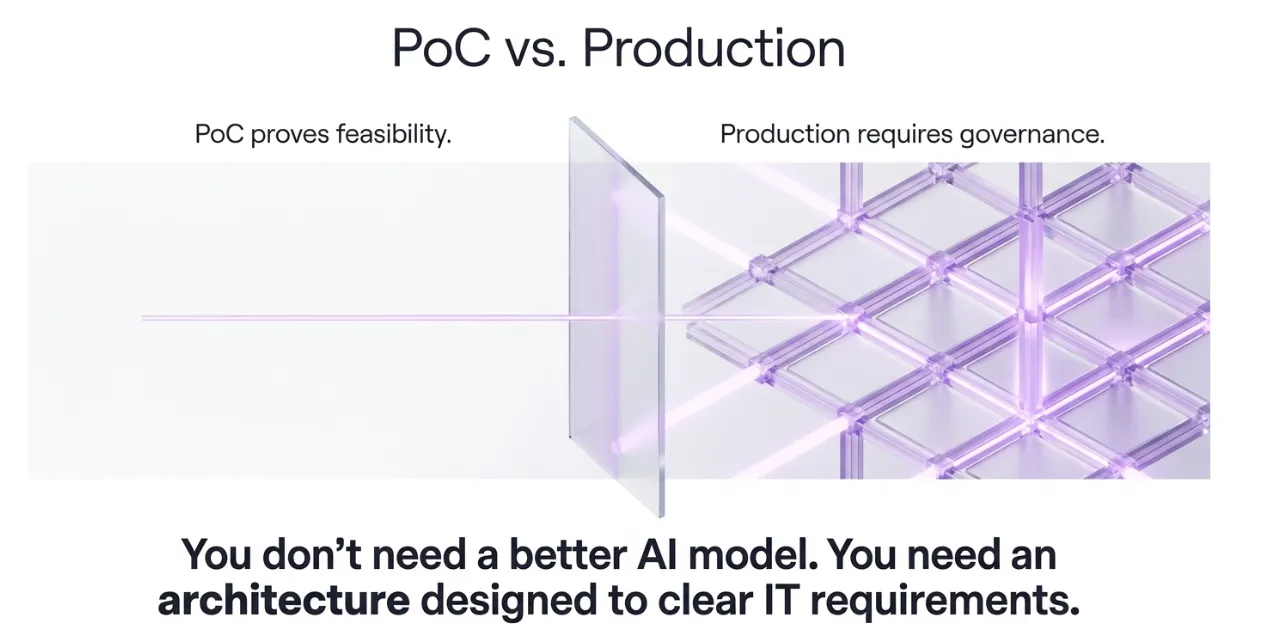
Why? Because the architecture was never designed to pass the company’s internal conditions.
The Real Blockers Are Not Technical. They Are Three Internal Conditions.
1. What Stops AI Projects First Is Connectivity
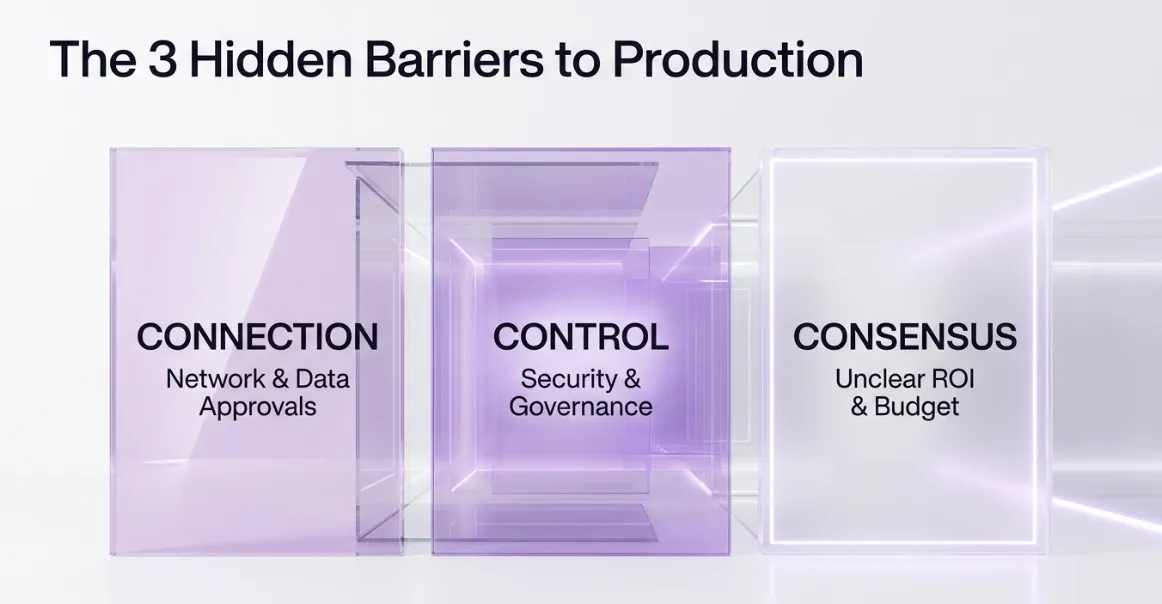
Many enterprise AI projects stop not because they fail technically, but because they fail the connectivity layer.
Typical blockers include:
- approval for external communications
- permission to use cloud APIs
- network segmentation requirements
- rules around data export
- vendor terms and conditions
- questions about whether submitted data is used for training
Even when the system itself is technically complete, projects can die at this stage.
Confluent’s 2026 research shows the same pattern in Japan. The top AI adoption challenges were:
- lack of AI and data skills and expertise (80%)
- uncertainty about data origin, timeliness, and quality (71%)
- lack of real-time data processing infrastructure (69%)
In other words, many enterprises are not failing at the model layer.
They are failing at the data connection layer.
2. What Stops Approval Is the Absence of Evaluation Standards
The number of security review items in a large enterprise can be overwhelming.
According to Assured’s survey, 79.9% of companies conduct AI security reviews both at the time of new contracting and on an ongoing basis, while 14.1% do so only at the time of a new contract. That means 94% are reviewing AI services in some form.
And yet 89.5% still say they face problems with AI security evaluation itself.
The two biggest reasons are:
- lack of people who can properly evaluate AI security (50%)
- unclear or unestablished AI evaluation criteria (49.1%)
This is the structure behind stalled approvals:
the company is asked to approve something that it does not yet know how to evaluate.
That is where internal approval slows down or stops.
There is also a second issue that makes the problem worse: hidden AI.
Not every risk comes from tools marketed as AI products. Some risks come from ordinary SaaS products that quietly added AI-based functionality. About one in three companies does not even verify whether the SaaS tools used in day-to-day operations include AI features.
Meanwhile, 58.5% of companies say they have experienced, or may have experienced, security incidents related to AI or AI-enabled SaaS.
Japan’s 2026 White Paper on Information and Communications also identified concern about the black-box nature of AI and the lack of explainability around how decisions are made.
This is why governance cannot be solved through prohibition alone.
The only sustainable answer is to make AI usage explainable, reviewable, and governable.
3. What Stops Budget Is the Lack of Agreement on How to Measure Results
The volume of meetings and internal coordination required for enterprise AI is usually far greater than expected.
Projects do not just need implementation. They need agreement on:
- responsibility boundaries
- operating ownership
- handling of failures and outages
- methods for measuring business impact
This is where budget often gets stuck.
PwC’s 2026 cross-country survey found that 13% of Japanese companies said they still could not evaluate the effects of generative AI. Among the six countries compared, Japan stood out. In the United States, that number was 0%.
Even in expectations around speed of returns, the gap is clear:
- U.S.: 66% expect measurable results within one year
- Japan: 41%
So what is really stalled is not AI itself.
What is stalled is the design of the conditions around AI.
Why PoC and Production Require Different Capabilities
A PoC tests technical feasibility.
Production tests governance, operations, and continuity.
That means production requires very different capabilities:
- permission design
- auditability
- data freshness and accountability
- integration into existing systems
- alignment across IT, legal, security, and business teams
The question being asked is completely different.
That is why it is perfectly natural for so many enterprise AI projects to stall after PoC.
Ridgelinez reported that only about one-third of companies working on generative AI PoCs make it all the way to production. Yano Research Institute’s 2025 survey also found that only 3.3% of companies were already using AI agents, while 13.5% were considering adoption and 49.3% were still in the information-gathering stage.
Many companies know how to build a PoC.
Very few know how to get enterprise AI through internal conditions and into production.
That is where the real competitive gap appears.
What Large Enterprises Actually Need: Architecture That Can Clear Internal Requirements Logically
The next-generation AIOS platform we continue to develop in-house, ARIA, is not just a concept. It is a foundation we have actually used in enterprise AI projects, including projects for major telecom carriers, where our team has handled the architecture and implementation directly.
ARIA is designed not simply as a productivity tool, but as a cognitive foundation that captures, preserves, and transfers organizational experience and judgment.
It includes:
- a self-learning loop
- P2P semantic distributed learning
- structured handling of tacit decision patterns that would otherwise remain locked inside individuals
- governance-aware architecture designed for enterprise security and operational safety
The more it is used, the more it converts organizational judgment into a reusable asset that improves enterprise-wide decision quality.
That is why Aezisai can support production deployment even under strict enterprise conditions.
The real reason enterprise AI adoption stalls is that connectivity, governance, and internal alignment are often treated as secondary issues. In practice, they are the core design problem.
We have accumulated know-how from real projects that have passed strict enterprise security reviews and internal approval processes.
Because there is a clear architecture that answers each company’s constraints, projects do not have to end at PoC. They can move into real production.
If Your Enterprise AI Project Is Stalling, the Problem May Not Be the Model
If your team is asking questions like:
- Which internal condition is most likely to block our AI project?
- How do we get internal IT review approved?
- How do we structure the approval process for AI adoption?
- How do we move from PoC to production without failing governance checks?
Then the issue may not be the model, the prompt, or the prototype.
It may be the absence of a design that can pass enterprise conditions.
Consultation
If you are struggling with where your AI initiative is likely to stall — or how to get internal IT review, security review, and approval workflows moving — we offer a 30-minute free online consultation to help organize your current issues.
Feel free to use it as a practical, informal starting point.
FAQ
Why do enterprise AI projects stall even when the technology works?
Because technical feasibility is only one part of enterprise AI adoption. Large companies also need approval for connectivity, security evaluation, governance design, auditability, and measurable business impact. Many projects succeed as PoCs but fail to meet these internal conditions.
What is the biggest internal blocker to enterprise AI adoption?
The biggest blockers are usually connectivity, governance, and internal alignment. These include cloud API approval, external communication policies, security review criteria, and agreement on how success will be measured.
Why do AI security reviews take so long in large enterprises?
Because many enterprises review AI services without having clear evaluation standards. According to 2026 survey data, 94% of large companies conduct AI security reviews, but 89.5% still struggle with the evaluation process. The main reasons are lack of specialized AI security talent and unclear criteria.
What is shadow AI in enterprise SaaS?
Shadow AI refers to AI usage that is not fully visible or governed by the company. This includes SaaS products that silently include AI features, or employees using AI-enabled tools without proper review. It creates governance and security blind spots.
Why do so many AI projects stop after PoC?
Because PoC proves that something can be built, while production requires much more: operational ownership, security review, legal alignment, auditability, and internal approval. These are different capabilities, and many organizations are prepared for the first but not the second.
What does an enterprise AI architecture need in order to reach production?
It needs more than model performance. It must support secure connectivity, governance, explainability, internal approval, auditability, and organizational reuse. In other words, it must be designed to clear enterprise conditions, not just technical tests.
Sources
- Ministry of Internal Affairs and Communications, 2026 White Paper on Information and Communications, Chapter 2: Progress of AI Use in Enterprises
https://www.soumu.go.jp/johotsusintoku/whitepaper/ja/r08/pdf/n1210000.pdf
- Teikoku Databank, Corporate Survey on Generative AI Trends (March 2026)
https://www.tdb.co.jp/report/economic/20260514-genai/
- Confluent, Data Streaming Report 2026
https://atmarkit.itmedia.co.jp/ait/articles/2608/26/news040.html
- PwC Japan, Generative AI Survey 2026 Spring: Six-Country Comparison
https://www.pwc.com/jp/ja/knowledge/thoughtleadership/generative-ai-survey2026.html
- Assured, Survey on AI Service Usage and Security Evaluation
https://assured.jp/column/shadow-ai-survey
- Ridgelinez, Press Study Session on Generative AI and PoC
https://it.impress.co.jp/articles/-/26925
- Yano Research Institute, 2025 Survey on AI Agent Adoption
https://www.yano.co.jp/report/press-release/show/press_id/3991